- Contact Us
- -
- Payment
- -
- 中文版
Knowledge Center · 2026-11-26 09:27:24 · 9 hits
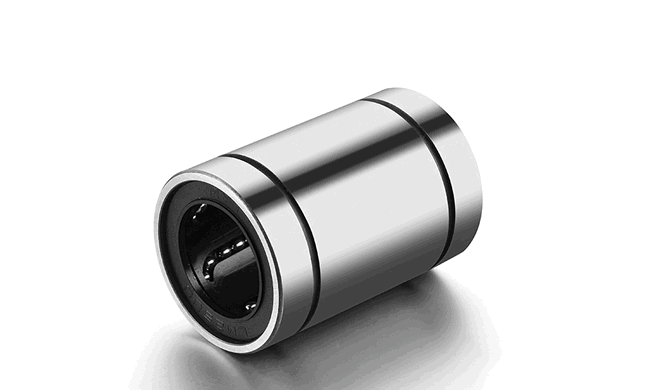
Standard linear bearings are designed for ambient or moderately elevated temperatures. Their balls, cage, sleeve, and lubricant each have a defined operating range. As temperature rises, the first thing to fail is rarely the bearing's ability to rotate—it is the lubrication condition, material properties, and dimensional stability. A bearing may still turn but show higher friction, increased noise, rough motion, and shortened life. For hot applications, therefore, the load rating alone is not enough; the permissible operating temperature of the complete assembly must be confirmed.
1. Why Standard Linear Bearings Are Not Directly Suitable
In a linear bearing, precision depends on small clearances, a stable lubricant film, and dimensionally stable components. Elevated temperature attacks all three at once. Even if the outer sleeve and balls remain mechanically sound, a softened cage, degraded grease, or a change in fit clearance can remove the accuracy the bearing was selected for. That is why "it still rotates" is not a valid qualification for high-temperature service.
2. Temperature Changes the Lubrication Condition
Greases and oils are highly temperature-sensitive. As temperature climbs, grease may soften, lose base oil through bleed, or evaporate; prolonged heat permanently degrades its lubricating performance. When the lubricant film becomes too thin, friction between balls and raceway rises, bringing noise, heat generation, and wear. Continuous high-speed reciprocation makes all of these effects more pronounced.
A high-temperature application cannot simply reuse the standard lubrication scheme. Check the two parameters that define a grease's useful range—its dropping point and the viscosity of its base oil—and confirm the relubrication interval at the actual operating temperature. Synthetic base stocks such as PAO, ester, silicone, or PFPE greases extend the usable range considerably compared with conventional mineral-oil greases.
3. Cages and Seals Can Become the Limiting Parts
The cage keeps the balls correctly spaced and guided. If its material softens, deforms, or loses strength at temperature, ball circulation becomes unstable and the bearing may jam or wear rapidly. Standard cages are often made from POM or sheet metal; for sustained heat, metal, PPS, PEEK, or phenolic retainers should be considered.
Sealed bearings add a further limit. Elastomer seals harden, soften, age, or fail once beyond their temperature rating. Typical guides are: NBR up to around 100 °C, FKM (Viton) to roughly 200 °C, and PTFE higher still—always verify against the supplier's data. Metal shields avoid elastomer limits but seal less effectively against fine dust. The fact that the bearing body tolerates a given temperature does not mean the seals or internal parts do.
4. Thermal Expansion Affects Fit Accuracy
In a hot mechanism the guide shaft, linear bearing, and housing all expand. When they are made of different materials, their coefficients of thermal expansion differ, and a clearance that was correct at assembly may change significantly at operating temperature. Too little clearance increases drag and can cause binding; too much introduces radial play and reduces motion accuracy.
Consider a 100 mm span heated by 60 K. A steel shaft (α ≈ 12 × 10⁻⁶/K) grows by about 0.072 mm, while an aluminium housing (α ≈ 23 × 10⁻⁶/K) grows by about 0.138 mm. The 0.066 mm difference is far larger than the normal running clearance of a linear bearing, which is typically only a few micrometres to a few tens of micrometres. For precision mechanisms, the fit must therefore be judged at the final working temperature, not at the cold assembly state.
5. High Temperature Combined with High Speed Is More Severe
A linear bearing generates frictional heat as it runs. If the ambient temperature is already high, internal heat from high-speed reciprocation pushes the actual bearing temperature even higher. "Hot + fast" is consequently much more demanding than a hot but static environment.
Under these conditions, material temperature rating alone is insufficient. Load, cycle frequency, stroke length, lubrication, and heat dissipation must be assessed together. If the bearing is already close to its rated temperature limit, raising speed or load will noticeably shorten its life.
6. How to Select for High-Temperature Service
First establish the actual bearing temperature, not merely the workshop ambient. A bearing mounted near a furnace, heat-treatment equipment, or a hot die can be heated by thermal radiation and conduction along the shaft well above room conditions.
Next check that the bearing material, cage, seals, and lubrication scheme are all rated for that temperature. For continuous hot service, choose a product with an explicitly stated high-temperature range rather than trying to extend a standard bearing with extra grease. Where high temperature coincides with high precision, high speed, and long life, re-evaluate the whole linear motion system—including shaft material, mounting structure, and the fit state after expansion.
7. Purchasing Advice
For high-temperature procurement, confirm continuous operating temperature, short-term maximum temperature, and the heat-up cycle before anything else. Then verify whether the bearing construction and materials can withstand those conditions over the long term.
If high-speed reciprocation is involved, also confirm the permissible speed and lubrication method at elevated temperature. If the machine sees large temperature differences, pay particular attention to the expansion relationship between shaft and bearing. For sealed bearings, check the seal material's temperature rating separately. A metal bearing body by itself does not make the whole product suitable for hot environments.
8. Common Misconceptions
Misconception 1: A metal linear bearing is automatically heat-resistant. The body may be steel while the cage, seals, and grease are not.
Misconception 2: Changing to high-temperature grease solves everything. If the cage, seals, or materials are unsuitable, grease alone cannot fix the problem.
Misconception 3: Ambient temperature equals bearing temperature. Conduction, radiation, and self-generated friction heat can make the bearing hotter than the surrounding air.
Misconception 4: Reaching the maximum rated temperature means continuous operation is safe. Continuous operating temperature and short-term peak rating are different figures.
FAQ
Q1: Can a standard linear bearing be used in a high-temperature environment?
It depends on the specific model's materials, lubrication, and seal construction. Appearance alone is not a reliable indicator.
Q2: Does heat shorten linear bearing life?
Yes. Degraded lubrication, material ageing, and changed fit clearances accelerate wear and reduce life.
Q3: Must unsealed bearings be used at high temperature?
Not necessarily. The need for sealing depends on temperature, dust, contamination, and the temperature capability of the seal material.
Q4: Why does a linear bearing bind at high temperature?
Common causes include lubrication failure, reduced clearance from thermal expansion, shaft-to-bearing misalignment, and deformation of internal parts.
Q5: What matters most when purchasing a high-temperature bearing?
First define the actual temperature and duty conditions, then verify materials, cage, seals, lubrication, and permissible running speed.
Copyright © 2016-2025 Forrun (Guangdong) Industrial Technology Co., Ltd All Rights Reserved.


