- Contact Us
- -
- USD
Knowledge Center · 2026-09-04 10:06:14 · 3 hits
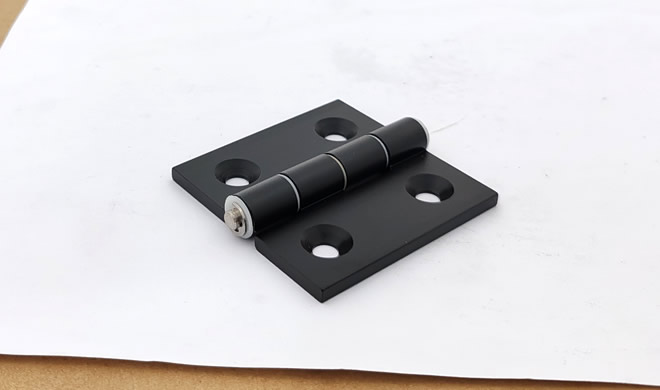
Hinge selection must take available installation space into full account.
A hinge does not occupy merely a fixed dimension after mounting. As the door or cover rotates, both the hinge assembly and its connecting components generate dynamically changing spatial envelopes. If engineers select hinges solely based on static dimensions such as length, width or load‑bearing capacity without evaluating rotational kinematic paths, post‑installation issues are likely to occur, including door‑to‑frame collision, mechanical interference, and insufficient opening angle. Consequently, both static mounting clearance and dynamic motion sweep space shall be evaluated during hinge specification.
Mounting thickness is one of the most easily neglected parameters. The height offset formed between the hinge body and door panel alters overall assembled dimensions. In compact‑layout equipment, insufficient allowance in this dimension may prevent the door from fully closing.
Pivot shaft position is equally critical. Variations in the distance from the pivot center to the door edge directly reshape the door’s sweeping trajectory during rotation. This dimension demands careful verification especially for flush‑mounted embedded doors and protective covers.
Do not estimate opening‑state clearance using only the hinge’s physical outline. The swinging door occupies substantial sweep volume throughout its rotation cycle. Adjacent cables, safety guards, machine frames and other moving components are high‑risk interference points that must be checked.
A hinge’s rated opening angle does not guarantee achievement of that angle under real‑world assembly conditions. Practical rotational range is constrained by door thickness, mounting layout and surrounding mechanical structures. For instance, even with a 180°‑rated hinge, adjacent frame features may physically block full door travel. At the selection stage, engineers shall simulate closed position, maximum open position and the complete motion cycle to identify potential interferences.
Proper clearance shall be reserved between door panels and equipment frames after hinge installation. Insufficient clearance leads to rubbing and impact during door operation. Excessive gaps degrade cosmetic appearance, enclosure protection performance and positional stability. For sheet‑metal cabinets and equipment safety guards, bending tolerances of sheet parts and mounting‑method‑induced spatial offsets also need to be factored into spatial budgeting.
One widespread mistake is judging installability purely by the hinge’s outer geometry. In practice, pivot location and door kinematic trajectory exert greater influence on final performance than the hinge body dimensions.
Another misconception assumes higher rated opening angle is always better. Without sufficient surrounding free space, a large‑angle hinge cannot deliver its full theoretical rotation capability within the mechanical assembly.
Why is installation‑space assessment necessary for hinge selection?
Mounted hinges define door placement and rotational paths. Insufficient available space results in mechanical interference and restricted opening travel.
What spatial parameters require primary verification?
Key items include mounting thickness, pivot‑shaft offset, mounting hole layout, door panel thickness, rated opening angle and dynamic sweep clearance.
Is a larger opening‑angle rating always preferable?
No. Specify opening angle according to functional requirements and available surrounding space of the machine.
Why reserve clearance between door and frame?
Clearance prevents friction and collision during opening‑closing cycles, while accommodating manufacturing and assembly tolerances.
How to select hinges for extremely compact spaces?Prioritize pivot layout and mounting configuration. Match compact‑form‑factor hinges after reviewing door thickness, target opening angle and surrounding interference boundaries.
Copyright © 2016-2025 Forrun (Guangdong) Industrial Technology Co., Ltd All Rights Reserved.


