- Contact Us
- -
- Payment
- -
- 中文版
Knowledge Center · 2026-09-08 09:39:36 · 7 hits
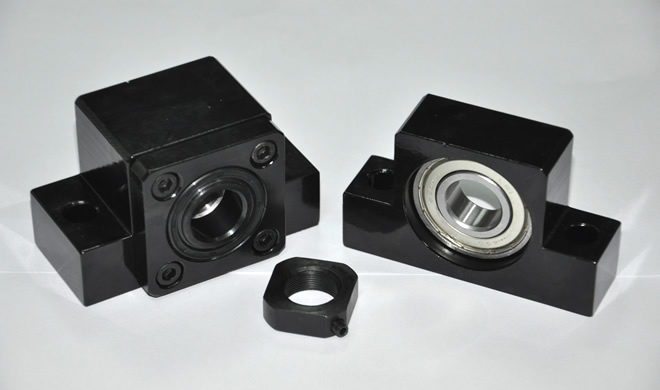
A technical overview of screw support bearings for factory automation systems
In factory automation (FA) systems, ball screw assemblies are the backbone of precise linear motion. The performance, accuracy, and service life of these assemblies depend heavily on one often-overlooked component: the ball screw support unit. This article explains what screw support units are, how fixed-side and support-side designs work, and how to install and maintain them for reliable, long-term operation.
1. What Is a Ball Screw Support Unit?
1.1 Definition
A ball screw support unit is a mechanical component used to fix and support both ends of a ball screw (or lead screw) assembly. It effectively prevents the screw from deflecting or vibrating during transmission—conditions that would otherwise degrade the working accuracy and stability of the equipment. Support units are typically supplied as standardized, ready-to-mount blocks (often square or round bodied) that integrate bearings, housings, and locking hardware.
1.2 Key Functions
The primary role of a screw support unit is to provide stable support points that maintain the straightness of the ball screw. A well-engineered combination of a fixed end and a floating (support) end can significantly improve system efficiency and extend service life. In addition, a properly designed support structure helps reduce noise and minimize energy loss caused by friction.
2. Types and Operating Principles
2.1 Fixed-Side Support Unit
Definition: The fixed side provides a fully constrained support at one end of the screw, preventing displacement in any direction. It typically incorporates a preloaded bearing arrangement (such as a pair of angular contact ball bearings) to eliminate axial play.
Principle: The fixed end achieves axial positioning of the screw through preloading, preventing axial movement caused by varying external loads. The preload is normally applied and adjusted via a lock nut, ensuring the screw remains in a consistently tensioned state. This rigid anchoring is essential for high-precision positioning.
2.2 Support-Side (Floating) Support Unit
Definition: The support side provides support at the opposite end of the screw while allowing a controlled degree of axial displacement—mainly to absorb thermal expansion and other length changes that occur during operation.
Principle: The support-side design maintains screw straightness while permitting axial freedom. Common configurations include floating bearings and angular contact ball bearings, which can carry radial loads while accommodating axial movement without inducing excessive stress in the screw.
3. Installation & Maintenance Guidelines
3.1 Installation
Fixed side: First ensure the screw is parallel to the guide rail, then use appropriate tooling to set the preload. Excessive preload increases friction resistance, while insufficient preload leads to inaccurate positioning.
Support side: Account for possible thermal expansion of the screw. Select bearings that accommodate axial displacement, and ensure no seizing or binding occurs as the screw elongates under operating temperature.
3.2 Maintenance
Routine inspection: Regularly check the screw and support units for wear. Replace damaged components promptly, and keep the assembly free of foreign particles that could interfere with smooth operation.
Lubrication: Periodic lubrication is essential for smooth operation. Choose a lubricant suited to the working environment and temperature to avoid premature lubrication failure and bearing damage.
4. Application Cases
4.1 Precision Machine Tools
Application: In precision machine tools, screw support units enable high-accuracy positioning. In CNC lathes, machining centers, and similar equipment, screw accuracy directly affects workpiece quality.
Results: Careful design of both fixed and support ends substantially reduces radial and axial runout, improving machining accuracy and extending screw life.
4.2 Industrial Robot Joints
Application: At robot joint sections, screw support units are widely used. They must support normal screw operation while withstanding the varied loads generated by joint motion.
Results: High-performance fixed and support units ensure smooth operation of robot joints under high-speed, high-precision requirements—boosting efficiency and lowering maintenance costs.
Copyright © 2016-2025 Forrun (Guangdong) Industrial Technology Co., Ltd All Rights Reserved.


