- Contact Us
- -
- Payment
- -
- 中文版
Knowledge Center · 2026-10-06 09:21:19 · 5 hits
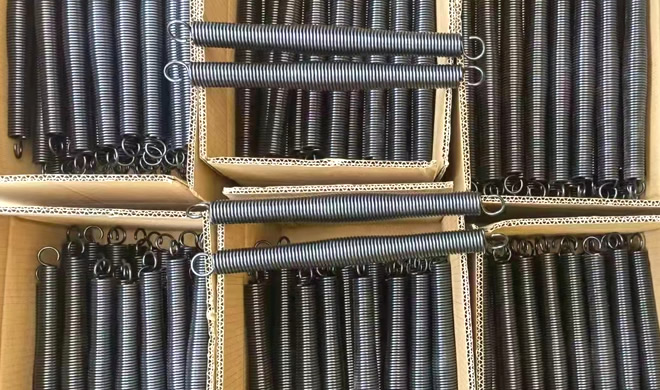
1. Definition and Function
1.1 Definition
A tension spring (also called an extension spring) is a mechanical element that stores energy or generates force through elastic deformation. It is made by coiling metal wire into a helix, so it stores energy when stretched and releases it as it returns to its original shape.
1.2 Main Functions
Restoring force: When pulled by an external force, it produces a restoring force opposite to the direction of stretch.
Energy storage: It stores mechanical energy through tensile deformation and returns it on recoil.
2. Classification and Operating Principle
2.1 Classification
By material: Carbon steel, stainless steel, and other materials are selected for different working environments (e.g., corrosion resistance, temperature).
By shape: Common forms include cylindrical and conical springs.
2.2 Operating Principle
Per Hooke's law, the deflection of a spring is proportional to the applied force:
F = k · x
where F is the force, x is the extension, and k is the spring rate (stiffness). The spring rate is not a material constant alone — it is governed by the material's shear modulus and the spring geometry (wire diameter, mean coil diameter, and number of active coils). This is why two springs of the same material can have very different stiffness.
3. Key Selection Parameters
3.1 Dimensions
Free length (L₀): The natural length of the spring with no load applied.
Inner / outer diameter: Determined by the available installation space (housing bore or mandrel).
3.2 Mechanical Properties
Spring rate (k): The force required per unit of extension; it defines the spring's working characteristic.
Maximum load capacity: The greatest tensile force the spring can safely withstand.
| Parameter | Sets / affects |
|---|---|
| Free length (L₀) | Installed length and initial gap |
| Outer / inner diameter | Fit to housing or mandrel |
| Spring rate (k) | Force produced per unit extension |
| Maximum load | Safe working limit |
| Wire diameter | Strength and stiffness |
3.3 End Type
The end form determines how the spring anchors to mating parts and how it handles misalignment.
| End type | Feature | When to use |
|---|---|---|
| Machine loop (standard) | Closed coil loop at both ends, in-line | General-purpose, purely axial loading |
| Extended hook | Loop on a short straight extension | Needs standoff / clearance from the mount |
| Cross-over hook | Loops on opposite sides | Compact, resists tangling |
| Swivel hook | Rotating hook end | Misaligned or moving anchor points |
4. Selection by Application
4.1 Industrial Equipment
High precision is required, so specify springs made to tight manufacturing tolerances.
Wear resistance and corrosion resistance are important considerations for duty life.
4.2 Consumer Products
Cost control matters, while basic functional requirements must still be met.
Appearance should also suit the overall product style.
4.3 Material Selection by Duty
| Material | Corrosion resistance | Strength / cost | Best for |
|---|---|---|---|
| Carbon steel | Low (needs plating) | High strength, low cost | Indoor, dry, cost-sensitive duty |
| Stainless 302 / 304 | Good | Moderate, higher cost | Humid or mildly corrosive environments |
| Stainless 316 | Excellent | Good, higher cost | Outdoor, chemical, marine duty |
| Music wire (high-carbon) | Low | Very high strength | High-fatigue, precision applications |
Quick Selection Checklist
Defined the required force at the target extension (use F = k·x).
Chosen material for the environment (stainless for corrosion, carbon steel for cost).
Confirmed free length and diameters fit the installation space.
Verified max load ≥ expected peak load with a safety margin.
Specified end type (loop / hook) compatible with mounting.
For fatigue duty, confirmed cycle-life rating.
5. Installation and Maintenance
5.1 Installation Points
Ensure accurate positioning to avoid eccentric (side) loading that causes uneven stress.
Check that mating parts are smooth so they do not abrade the spring surface.
5.2 Maintenance Recommendations
Periodically inspect spring condition and address any abnormality promptly.
Keep the spring and its surroundings clean and dry.
6. Application Cases
6.1 Automotive Suspension
Effectively absorbs road shock to improve ride comfort.
Requires good fatigue resistance for long service life.
6.2 Electronic Switch Devices
Provides appropriate trigger-force feedback for buttons.
Spring parameters must be precisely controlled to ensure switch sensitivity.
7. Common Issues
| ssue | Likely cause | Corrective action |
|---|---|---|
| Premature breakage | Overload, sharp bend at hook, fatigue | Lower load; increase wire diameter; use larger bend radius |
| Loss of force (set / relaxation) | Exceeded elastic limit | Keep within max load; specify pre-set manufacturing |
| Corrosion | Wrong material for environment | Switch to stainless or plated version |
| Tangling in bulk | Loose coils, hooked ends | Use sorted packaging or cross-over ends |
| Hook deformation | Side load / eccentric pull | Align load axis; use swivel hook |
Copyright © 2016-2025 Forrun (Guangdong) Industrial Technology Co., Ltd All Rights Reserved.


