- Contact Us
- -
- Payment
- -
- 中文版
Knowledge Center · 2026-11-02 09:51:40 · 14 hits
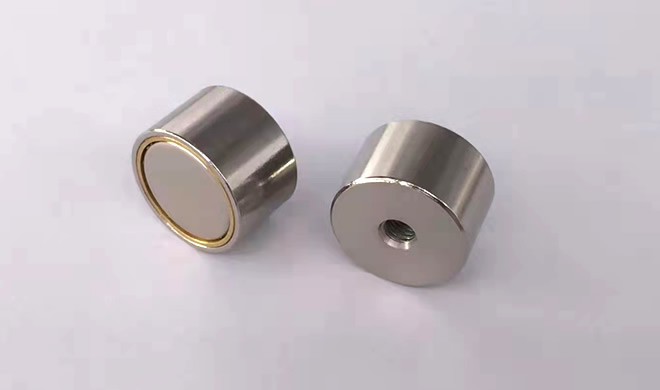
1. Classification and Magnetic Mechanism
A magnet is a material that produces a magnetic field and attracts or repels ferromagnetic materials; magnets are widely used in automation equipment, sensors, and holding structures.
By source of magnetism, materials fall into permanent magnets and electromagnetic materials. In industry the common case is the permanent magnet, whose magnetism comes from the ordered alignment of magnetic domains within the material. The underlying material system determines the key performance figures — maximum energy product, coercivity, and temperature stability.
2. Common Magnet Types and Differences
The main industrial types are:
Neodymium–iron–boron (NdFeB). Strongest for its size, but relatively weaker in temperature resistance and corrosion resistance.
Ferrite (ceramic). Low cost and good corrosion resistance, but weaker magnetic strength.
Samarium–cobalt (SmCo). Excellent high-temperature performance and stability, but higher price.
Alnico (Al–Ni–Co). Good temperature stability, but lower resistance to demagnetization.
Each type involves a clear trade-off between performance and cost.
Typical comparison (values are grade-dependent, for guidance only):
| aterial | Max energy product (BH)max | Max working temp | Corrosion resistance | Relative cost | Typical use |
|---|---|---|---|---|---|
| NdFeB | ~200–440 kJ/m³ (25–55 MGOe) | 80–200 °C | Low (needs coating) | High | Compact high-force holding, motors, sensors |
| Ferrite | ~8–40 kJ/m³ (1–5 MGOe) | 250–300 °C | High | Low | Cost-driven holding, general use |
| SmCo | ~120–240 kJ/m³ (15–30 MGOe) | 250–350 °C | Moderate | Very high | High-temperature, stable precision devices |
| Alnico | ~10–80 kJ/m³ (1.2–10 MGOe) | 450–550 °C | Moderate | Moderate | High-temperature, low-drift instruments |
3. Key Performance Parameters
Magnet selection should focus on these parameters:
(1) Maximum energy product (BH)max. The maximum magnetic energy per unit volume; the key indicator of magnetic strength for a given size.
(2) Coercivity (Hc). The resistance to demagnetization; it directly affects stability in demanding environments.
(3) Remanence (Br). The magnetic flux density remaining after the external field is removed.
(4) Working temperature range. Different materials degrade by different amounts at high temperature.
Together these parameters determine how a magnet actually performs in service. (Units: (BH)max in kJ/m³ or MGOe; Hc and Br in kA/m and tesla; temperature in °C.)
4. Application Selection and Matching Strategy
High holding force in a small volume: prefer NdFeB.
High-temperature environment: choose SmCo or Alnico.
Cost-sensitive application: choose ferrite.
High long-term stability requirement: prioritize high-coercivity materials.
Outdoor or humid environment: allow for anti-corrosion coating or a naturally corrosion-resistant material.
Selection should balance performance, environment, and cost.
5. Risks and Common Misconceptions
(1) "Stronger is always better." Excess magnetic force can complicate assembly or create interference (e.g., with sensors or adjacent ferrous parts).
(2) Ignoring temperature effects. High temperature can cause irreversible demagnetization.
Risk: Demagnetization or corrosion leads to loss of holding force and can compromise equipment function.
6. Safety and Handling Notes
Strong NdFeB magnets can pinch fingers and snap together; handle with care and use fixtures where needed.
Keep magnets away from sensors, encoders, magnetic media, and sensitive electronics to avoid interference.
Attracting chips and debris can damage sliding surfaces or contaminate the mechanism — add a cover or a clean-down routine where fine work is done.
7. FAQ
Q: Will a magnet keep its magnetism forever? Under normal conditions it holds magnetism for a long time, but high temperature or a strong opposing field can cause demagnetization.
Q: How do I prevent a magnet from rusting? Use protective measures such as nickel plating or an epoxy coating.
Q: Can magnets be machined? Hard magnets are difficult to machine; design features usually need to be completed before forming/sintering.
Q: How do I choose between NdFeB and SmCo? NdFeB when you need maximum force in minimum volume and temperature is moderate; SmCo when temperature and stability matter more than cost.
Q: What causes a magnet to lose strength? Heat, opposing external fields, physical shock or cracking, and corrosion.
Copyright © 2016-2025 Forrun (Guangdong) Industrial Technology Co., Ltd All Rights Reserved.


