- Contact Us
- -
- Payment
- -
- 中文版
Knowledge Center · 2026-10-28 09:55:22 · 5 hits
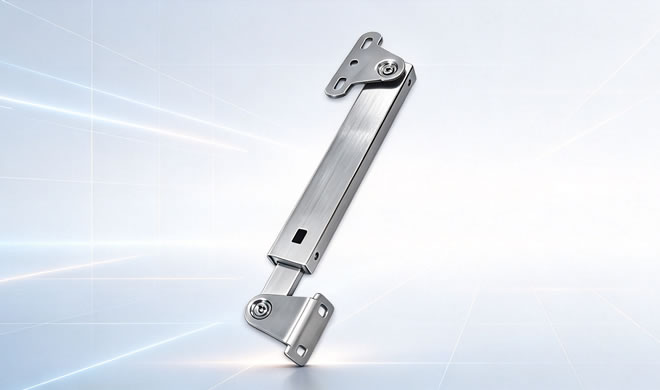
1. The Role of Stays in Structural Support
Lid and flap stays are fitted to equipment guard doors, cabinet top covers, service hatches, and a wide range of flip-open or hinged structures. Their primary functions are to support the panel in the open position, damp its motion, and limit how far it swings. Because a stay delivers force along a fixed line, its installation angle directly sets how much of that force actually holds the panel up and how stable the whole assembly feels.
2. Installation Angle and the Force Relationship
2.1 How the angle governs supporting force
A stay works by pushing or pulling along its own axis. Only the component of that axial force acting against gravity does useful supporting work:
F_vertical = F × sin α
where F is the stay's axial force and α is the angle between the stay axis and the horizontal (the panel/reference plane). The closer the stay stands to vertical (α → 90°), the larger the vertical component — and the smaller the stay needed for the same job. As α shrinks toward horizontal, the vertical component collapses: at α = 20° only about 34 % of the axial force is usable, so a much larger stay is required.
2.2 How the angle shapes load distribution
A well-chosen angle also lets the stay carry load in near-pure axial tension/compression. This spreads the reaction more evenly and cuts the local stress concentration at the hinge eyes and mounting bosses, raising overall reliability.
3. Typical Behavior at Different Angles
| Angle zone | Vertical efficiency (sin α) | Side-load tendency | Practical outcome |
|---|---|---|---|
| Too small (near horizontal) | Low | High | Needs an oversized stay; extra wear on mounts |
| Moderate (recommended) | High | Low | Stable support, smooth motion, long life |
| Too large (over-extended) | High at rest, weak through travel | Low | Insufficient hold at initial opening; possible slam/shock |
3.1 Angle too small. Support efficiency is poor, so a bigger or stronger stay is needed to meet the same requirement. Worse, the off-axis loading generates a pronounced side (lateral) force that accelerates wear of the end fittings and mounting holes.
3.2 Moderate angle — the sweet spot. Inside the recommended range the stay delivers stable support and the panel opens and closes smoothly, which protects both the stay and the hinge over the long term.
3.3 Angle too large. If the stay is mounted too steeply, it can pass through a dead point near the initial opening position, where its line of action runs close to the hinge and provides little holding torque. The result is a panel that is hard to start lifting and may then drop or slam with impact.
4. Angle Selection by Application
Cabinet doors and equipment top covers: use a moderate angle that balances easy opening with steady support.
Heavy flip-open structures: increase the angle (toward vertical) to raise the usable vertical component without oversizing the stay.
Space-constrained structures: when the available angle is limited, compensate for the lost vertical component by specifying a larger stay or adding a second stay, rather than forcing an awkward geometry.
5. Integrated Design and Installation Guidance
Sizing and fitting a stay should not be done by eye. Combine the panel weight, the required opening angle, the available installation space, and a safety factor into the calculation:
Estimate the panel weight and its center-of-gravity moment about the hinge.
Determine the stay force and mounting geometry needed to balance that moment through the full opening travel.
Choose an installation angle in the recommended range — high enough for good vertical efficiency, clear of the dead-point at initial opening.
Apply a safety factor (commonly 1.5–2 for manual-access panels) to the required force.
Verify end-fitting ratings, mounting-hole strength, and clearance at both the closed and fully open positions.
A correct installation angle not only improves support; it also reduces wear and the risk of long-term failure, making it a factor that should never be left to chance in structural design.
6. Common Pitfalls Checklist
Mounting the stay near horizontal "because it fits" — silently halves or worse the usable force.
Ignoring side load — off-axis force, not axial force, is what breaks end fittings.
Forgetting the dead point — check support at the initial opening position, not just fully open.
Sizing from rest force alone — gas and spring stays vary through travel; use the worst-case point.
Skipping the safety factor on access panels that people open by hand.
7. FAQ
Q: Can I just pick a bigger stay instead of fixing the angle? You can, but a poor angle also creates side load and dead-point problems a bigger stay won't cure — fix the geometry first.
Q: What is the "dead point"? The position where the stay's line of action passes through (or very near) the hinge, so it generates almost no holding torque about the hinge.
Q: Is a more vertical stay always better? Up to a point: vertical gives maximum vertical force, but too steep an angle can push the stay into a dead-point at opening. Moderate is the goal.
Q: How do I compensate when space only allows a small angle? Increase the stay force/size or use two stays, and keep the safety factor conservative.
Copyright © 2016-2025 Forrun (Guangdong) Industrial Technology Co., Ltd All Rights Reserved.


