- Contact Us
- -
- Payment
- -
- 中文版
Knowledge Center · 2026-08-17 09:49:17 · 207 hits
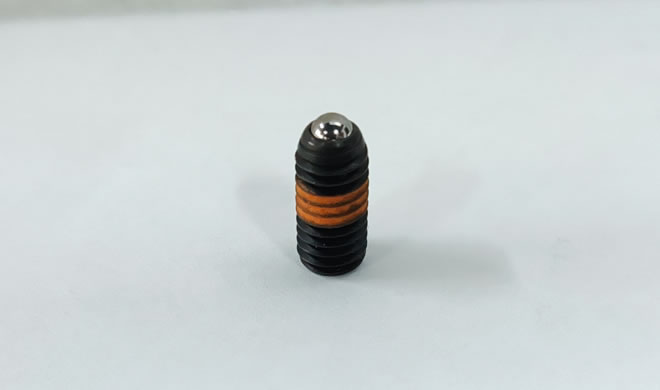
Ball plungers perform positioning functions relying on integrated springs, steel balls and threaded mounting structures. When properly installed, ball plungers remain firmly secured, and the retractable steel ball enables component positioning and stroke limiting. Loose ball plungers manifest as unwanted rotation after assembly, positional drift, abnormal ball retraction‑extension behaviour, or rattling of the mated target part. Loosening deteriorates positioning performance. Under sustained vibration and cyclic motion in automated machinery, positional deviation may occur, severely compromising the repeat positioning accuracy of mechanical assemblies.
Ball plungers are predominantly mounted via threaded joints. Insufficient insertion depth or inadequate tightening torque leaves threaded connections vulnerable to gradual loosening under operational vibration and shock. In factory‑automation equipment, cyclic vibration generated by frequent mechanism actuation accelerates displacement of ball plungers in the absence of anti‑loosening countermeasures.
Incompatible thread tolerances between the external thread of the ball plunger and the tapped mounting hole reduce effective thread engagement length and joint strength. Typical triggers include poorly machined mounting holes, worn internal threads or incorrect thread‑size selection, all of which prevent rigid, stable fastening of the ball plunger.
High‑speed operation and frequent start‑stop cycles in FA systems generate continuous dynamic shock and vibration. Subjected to these cyclic loads, micro‑displacement arises at threaded interfaces, gradually reducing pre‑tightening torque and eventually resulting in loosening failure.
When ball plungers are fitted into aluminium extrusions, polymer components or thin‑wall structures, material creep and local deformation may occur around the tapped hole under prolonged loading. Clearance within the threaded fit increases accordingly. Even with an intact ball plunger, loosening symptoms will emerge due to substrate deformation.
Remedial actions shall correspond to the root cause identified on‑site. For installation‑related loosening, inspect threaded engagement status and implement suitable anti‑loosening treatments matched to operating conditions. Thread‑locking adhesives are widely adopted for high‑vibration applications to secure long‑term joint stability.
If poor mounting‑hole quality is the source of failure, re‑verify machining dimensions and thread integrity to achieve proper thread fit. For high‑cycle automated equipment, validate whether the selected ball‑plunger model satisfies application requirements. Insufficient spring force or inadequate load capacity will degrade positioning performance, calling for respecification of ball plungers to match actual working conditions.
Ball plungers are often regarded as simple low‑cost positioning hardware, while the influence of operating environment on long‑term reliability gets underestimated. Beyond pure positioning force, ball plungers in automation are commonly exposed to vibration, lateral side‑loads and repeated impact events. Undersized part selection or inappropriate mounting practices will trigger premature loosening.
It is critical to note that ball plungers are not structural fasteners designed to sustain heavy static loads or major impact forces. Relying solely on ball plungers to bear component weight or heavy shock will result in permanent damage to steel balls, internal springs and threaded sections.
Select ball‑plunger specifications according to real‑world operating scenarios. For basic positioning and limit‑stop duties, focus on thread size, ball diameter and built‑in spring force. For automated machinery and jigs & fixtures, prioritise repeat actuation cycles, vibration exposure and long‑term operational stability.
Where high‑speed movement or prominent shock exists, specify ball plungers with proven anti‑loosening features and sufficient mechanical strength to prevent in‑service positional shift. Meanwhile, evaluate substrate material strength and available installation envelope to guarantee full functional performance of ball plungers.
Many technicians assume retightening alone can fully resolve loose ball‑plunger issues. Where loosening originates from thread wear, mounting‑hole deformation or wrong model selection, simple re‑torquing delivers only temporary improvement without eliminating underlying failure sources.
In addition, higher spring force does not always equal better positioning performance. Ball plunger selection shall balance positioning accuracy, actuation frequency and applied load. Excessive spring force will introduce unnecessary operating resistance to the mechanism.
Why do ball plungers turn loose after a period of operation?
Loosening is generally attributed to vibration, shock loading, insufficient thread engagement, improper installation or deformation of the mounting substrate.
Will loose ball plungers affect equipment accuracy?
Yes. Looseness induces component positional shift and reduces repeat positioning accuracy of mechanical assemblies.
Is thread‑locking adhesive required for ball plungers?
Implement appropriate anti‑loosening methods based on application requirements, especially for equipment operating under heavy‑vibration conditions.
Should ball plungers be tightened as much as possible?
No. Reliable fastening is required, yet over‑torquing must be avoided to prevent thread stripping and permanent thread damage.
How to extend the service life of ball plungers?
Service life can be maximised through proper model selection, correct installation, favourable operating‑condition control and avoidance of overload conditions.
Copyright © 2016-2025 Forrun (Guangdong) Industrial Technology Co., Ltd All Rights Reserved.


