- Contact Us
- -
- Payment
- -
- 中文版
Knowledge Center · 2026-08-14 10:39:33 · 179 hits
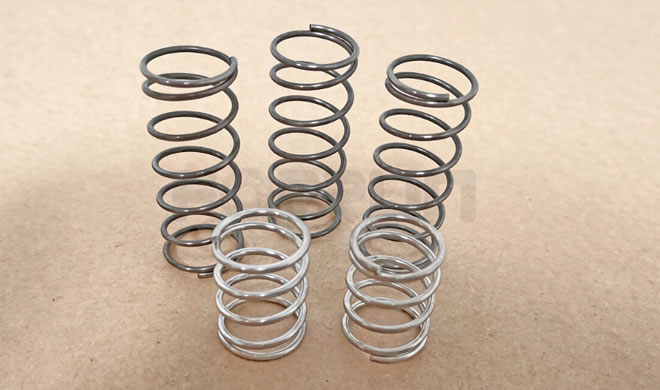
When selecting compression springs, mounting space is generally the first‑point condition to confirm. The reserved internal space of equipment defines the allowable dimensional range for springs, while working load and service life determine the final spring specification. In practical FA applications, engineers shall first clarify constraints at the installation position, such as mounting bore size, clearance to adjacent components, and allowable compressible working height. Based on these spatial constraints, engineers can match the suitable outer diameter, free length and structural style for the compression spring. If spring selection is performed merely according to spring force requirements without considering spatial limits, common risks may occur: the spring cannot fit into the assembly, interference with surrounding parts during compression, or deflection and tilting in operation.
Mounting space primarily governs the selection of spring outer and inner diameters. For springs fitted inside a bore, the outer diameter must be smaller than the bore dimension with adequate clearance reserved, so as to prevent frictional contact between spring coils and bore walls under compression load. When assembled with a guide rod, reasonable clearance shall be maintained between the spring inner diameter and guide‑rod diameter. Insufficient clearance will raise motion resistance and shorten spring service life.
Besides diameter constraints, available installation height restricts the allowable free length. Compact mechanisms with limited space often adopt shorter springs; target spring force can be achieved by increasing spring stiffness or wire diameter. Conversely, assemblies with ample space may employ longer springs to deliver smoother working stroke performance. It should be noted that larger dimensions do not always equal better performance; springs must satisfy functional requirements within given spatial boundaries.
The free length of a compression spring shall be defined against the actual mechanical stroke of automated equipment. Where installation height is limited yet large compression travel is required, avoid designing the spring to reach solid height during operation. Once compressed to solid state, adjacent coils make full contact, resulting in sharp stress rise. Continuous operation under solid compression will cause permanent set and early failure.
In typical automated mechanisms including clamping units, positioning assemblies and return‑reset structures, working spring length shall be calculated from actual travel distance instead of simply picking a spring that physically fits in place. The recommended workflow is to confirm the required compression stroke first, then select proper free length based on remaining installation height. This approach guarantees sufficient spring force while preventing sustained extreme compression.
When mounting space is constrained with little room for dimensional adjustment, target spring force can be realized by tuning spring parameters. Increasing wire diameter raises spring stiffness, enabling higher load‑bearing capacity within compact envelope dimensions. Optimized raw material and structure design can also improve fatigue resistance.
Nevertheless, excessive stiffness brings drawbacks. Over‑rigid springs generate severe mechanical impact during actuation, which may degrade positioning accuracy and operational stability of automated machinery. Under space‑limited conditions, balance shall be struck among installation dimensions, spring‑force demand and motion smoothness, rather than pursuing maximum spring force blindly.
Beyond dimensional fitting, operating environment of equipment must be evaluated. Standard off‑the‑shelf compression springs are sufficient for manual assemblies or low‑cycle‑rate equipment. For high‑speed reciprocating mechanisms widely used in factory automation, fatigue life and material properties become critical given repeated cyclic compression. Long springs tend to buckle and deflect under compression; auxiliary guiding structures are recommended to enhance operational stability.
Furthermore, for working conditions exposed to dust, moisture or corrosive media, material grade and surface treatment shall be properly specified to mitigate rusting and gradual spring‑force degradation over service time.
Field symptoms during equipment operation help verify spring matching status. Incomplete mechanism actuation usually indicates insufficient spring force or inadequate stiffness. Obvious impact noise during movement may stem from over‑high stiffness or unreasonable compression‑ratio design. Permanent height reduction, decaying spring force or spring fracture after running for a period are normally caused by over‑compression, excessive fatigue cycles or misaligned installation.
Qualified spring selection covers not only physical fit‑in, but also long‑term reliability under real‑world working conditions.
For compression spring selection constrained by mounting space, define feasible dimensional boundaries first, then match specifications according to compression stroke, working load and environmental conditions. Mounting space determines spring geometric dimensions, while load requirements govern stiffness and structural parameters. Properly‑specified compression springs ensure reliable mechanism movement, reduce risks of spring‑force attenuation, fatigue fracture and unstable operation, and improve overall equipment uptime.
Is mounting dimension the only criterion for compression spring selection?
No. Mounting dimension serves as a fundamental constraint. Working spring force, compression stroke and expected service life must also be taken into comprehensive consideration.
Does smaller outer diameter mean better performance?
No. Outer diameter shall comply with mounting limits while guaranteeing sufficient load capacity and stable operation.
Why does spring force drop after long‑time service?
Major root causes include repeated operation beyond designed compression limit, material fatigue, corrosive working atmosphere, and misaligned installation leading to eccentric loading.
How to increase spring force when mounting space is insufficient?
Stiffness can be improved by adjusting wire diameter, raw material or spring structure. Meanwhile, mechanical motion smoothness shall not be compromised.
Is a guide rod mandatory for compression springs?
Guide rods are highly recommended for long springs or high‑speed reciprocating applications to suppress deflection and extend spring service life.
Copyright © 2016-2025 Forrun (Guangdong) Industrial Technology Co., Ltd All Rights Reserved.


