- Contact Us
- -
- Payment
- -
- 中文版
Knowledge Center · 2026-09-16 09:22:20 · 5 hits
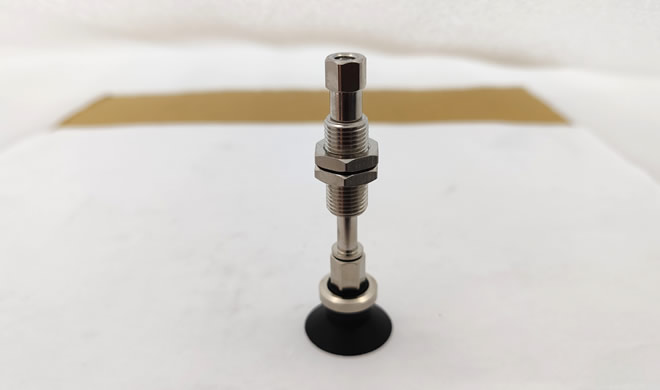
Why Surface Irregularity Affects Vacuum Holding
Whether a vacuum cup holds a workpiece reliably comes down to one thing: a stable seal between the cup and the workpiece surface. On flat sheet stock, the cup's sealing lip conforms fully to the surface. But when the part has pits, protrusions, curved sections, or irregular edges, gaps can open in the sealing zone and air keeps leaking into the cup, so the required vacuum level cannot be built up. This does not mean uneven surfaces are off-limits for vacuum handling—it means the cup must have enough compliance and compensation capability for its sealing lip to follow local surface variations.
Flexible Cups Improve Conformance
For parts with slight dimples, press marks, or distortion, prioritize cups with a softer, more flexible lip. The lip can deform locally to close gaps and improve the seal.
If the surface has pronounced curvature, consider bellows (corrugated) cups or structures with axial compensation. After contact, such a cup can travel through a defined stroke, letting multiple cups land simultaneously on positions at different heights and reducing uneven loading caused by height differences across the part.
Control Leakage on Rough Surfaces
For castings, wood, frosted/sandblasted materials, or other rough surfaces, even a globally flat shape can leak continuously through microscopic pores. When selecting a cup for these parts, focus on the softness of the sealing lip and the cup's conformability. At the same time, size the vacuum generator and line according to the actual leakage. A vacuum system should not simply chase a higher vacuum level—it must retain enough evacuation capacity to hold a stable negative pressure even while air is leaking in.
Adjust Cup Layout for Complex Shapes
For parts with local protrusions or large height differences, swapping in a different cup type alone may not solve the problem. Instead, increase the number of cups, relocate them, or use independently compensated mounts so each cup adapts to its own surface region. Where curvature changes sharply, also consider the cup's mounting angle and its swivel capability. Forcing a cup against a curved surface at a fixed attitude causes partial contact, incomplete sealing, and uneven part loading.
Purchasing Recommendations
When choosing vacuum cups for uneven workpieces, first characterize the surface: flatness, curvature, roughness, degree of unevenness, and whether the material is easily deformed. For lightly uneven surfaces, prefer a flexible sealing lip; for curved or height-varying parts, consider bellows cups and compensated structures; for rough, leak-prone parts, focus on seal performance and the generator's sustained pumping capacity.
For handling equipment, do not judge stability on rated suction force alone—calculate the actual safety margin. The required secure force must cover both gravity and acceleration:
F_required = m × (g + a) × SF
F_secure = n × F_cup × cosθ × SF
where m = workpiece mass, g = gravity, a = handling acceleration, n = number of cups, F_cup = rated holding force per cup, θ = cup tilt angle, and SF = safety factor (typically ≥ 2.0, higher under shock or high acceleration). Select cups so that F_secure ≥ F_required across all operating conditions.
Cup Type Selection Matrix
| Surface Condition | Recommended Cup Type | Key Consideration |
|---|---|---|
| Lightly uneven (dimples, press marks, slight distortion) | Flexible cup (soft lip) | Lip deforms locally to close gaps |
| Curved / height-varying | Bellows (corrugated) cup, or axial-compensated structure | Stroke compensates height differences; multiple cups land simultaneously |
| Rough / porous (castings, wood, frosted) | Soft-lip cup + adequately sized vacuum generator | Sustained pumping capacity against continuous leakage |
| Sharp curvature / complex shape | Swivel / angular-compensated mounts + optimized layout | Avoid forced fixed-attitude contact; keep load even |
| Heavy load / high acceleration | Multiple cups + safety-margin calculation (above) | Judge by safety margin, not rated force alone |
Common Misconceptions
A common misconception is that raising the vacuum level fixes every uneven-surface problem. If a clear leakage path exists between cup and part, higher vacuum cannot substitute for a proper mechanical seal. Another is sizing cups by workpiece weight alone. For uneven parts, the real limit on holding stability is often leakage, insufficient contact area, or the cup's inability to compensate for height differences—not merely the cup's theoretical suction force.
FAQ
Q: Can vacuum cups still be used on uneven workpieces?
A: Yes—but choose a cup structure with flexibility or compensation suited to the surface shape.
Q: What cup suits a slightly uneven surface?
A: Usually a more flexible cup, so the sealing lip can follow local dimples and marks.
Q: How should I select cups for curved workpieces?
A: Consider bellows cups, flexible cups, or structures with some swivel and compensation capability.
Q: Why do rough surfaces tend to show insufficient vacuum?
A: Microscopic pores cause continuous leakage, making it hard to maintain a stable negative pressure inside the cup.
Q: Do uneven workpieces require more cups?
A: Not necessarily—but adding cups sensibly and optimizing their layout helps distribute load and improve overall holding stability.
Copyright © 2016-2025 Forrun (Guangdong) Industrial Technology Co., Ltd All Rights Reserved.


