- Contact Us
- -
- Payment
- -
- 中文版
Knowledge Center · 2026-09-17 09:41:32 · 7 hits
1. Basic Concept
Definition
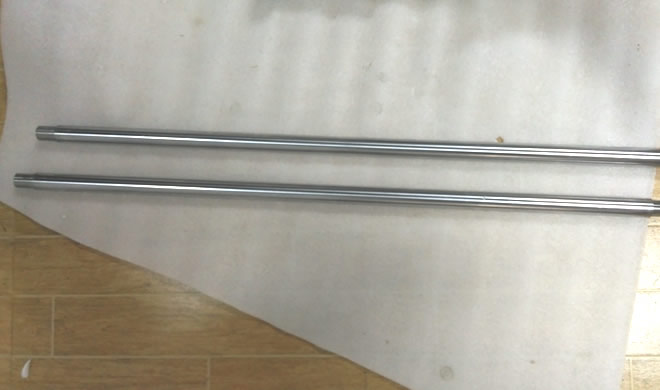
A guide shaft is a key component in mechanical systems used to guide a moving part along a precise straight or curved path. It consists mainly of the shaft body, the guiding surface, and a support structure, ensuring stability and accuracy throughout the motion.
Function
In precision assembly, automated production lines, and similar settings, guide shafts ensure that workpieces or machine components follow a predetermined trajectory. They reduce friction, improve operating efficiency, and extend equipment service life.
2. Classification by Tolerance
By Tolerance Grade
Standard-tolerance guide shaft – for general-accuracy needs, such as ordinary conveyor lines and simple positioning devices.
High-precision guide shaft – for applications demanding extremely high accuracy, such as precision measuring instruments and high-end CNC machines.
Tolerance Grade — Application — Mating Component (Reference)
| Tolerance Class | Typical Application | Typical Mating Component |
|---|---|---|
| Standard (e.g., h8–h10, as-machined) | Conveyors, simple positioning, jigs | Plain / oil-free (slide) bushings |
| Precision (e.g., g6 / h6, ground) | Packaging, logistics automation, general FA | Linear bushings, flanged bushings |
| High-precision (e.g., g5 / h5, lapped) | CNC, measuring instruments, semiconductor, medical | Precision / ball bushings |
(In practice, precision linear shafts are commonly finished to a g6 or h6 fit and paired with the corresponding linear bushing; tolerance is specified per ISO IT grades, with higher classes for tighter fits.)
By Material
Stainless steel – strong corrosion resistance; suited to humid or chemically aggressive environments.
Carbon steel – lower cost and high strength; suitable for most industrial settings.
Aluminum alloy – light weight and good thermal conductivity; preferred for high-speed operation.
3. Specific Applications by Tolerance Class
Standard-Tolerance Guide Shafts
Logistics automation – in automated sorting systems, they ensure smooth, stable transfer of goods.
Packaging machinery – used in sealing, cartoning, and similar stages to maintain continuous, reliable operation.
High-Precision Guide Shafts
Semiconductor manufacturing – during wafer processing, they deliver the micron-level accuracy the process demands.
Medical equipment – in CT scanners, MRI machines, and the like, high-precision shafts are critical to imaging quality.
4. Factors in Selecting the Right Tolerance Class
Accuracy Requirement
Choose a guide shaft whose tolerance meets the specific demands of the application. For extremely demanding scenarios, prioritize a high-precision shaft.
Environmental Conditions
Account for temperature, humidity, and corrosiveness, then select suitable material and protection. Under special conditions—high/low temperature, strong acid/alkali—custom materials or surface treatments may be required.
Cost Budget
High-precision shafts usually cost more, but in critical applications their long-term benefit far outweighs the added cost. For non-critical uses, a standard-tolerance shaft offers better cost-performance.
5. Surface Treatment & Service Life
The shaft's working surface largely determines wear life and compatibility with its bushing, so surface treatment is often specified alongside tolerance.
Hard chrome plating – Deposits a thin, hard, low-friction layer (typically 5–20 µm) that improves both wear and corrosion resistance. It is the most common finish for guide shafts in automation.
High-frequency induction hardening – Raises surface hardness to roughly HRC 58–62 with a shallow case depth (~0.5–2 mm), boosting fatigue and wear life while keeping the core tough.
Lifespan considerations: actual service life depends on load, sliding speed, lubrication, and contamination. A proper fit, adequate lubrication, and a clean environment extend life; scratches, corrosion, or an oversized bushing will accelerate wear of both the shaft and its mating component.
Copyright © 2016-2025 Forrun (Guangdong) Industrial Technology Co., Ltd All Rights Reserved.


