- Contact Us
- -
- Payment
- -
- 中文版
Knowledge Center · 2026-09-28 09:45:51 · 12 hits
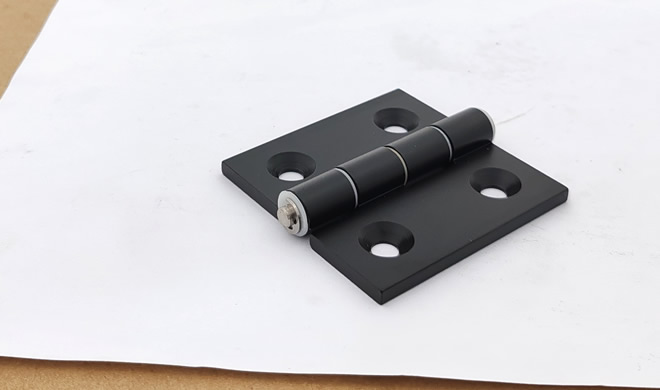
Industrial enclosures, control cabinets, and electrical panels rely on their doors not only to keep contents accessible, but to maintain ingress protection, EMC shielding, and structural rigidity. The hinge is a small component that quietly determines whether a door opens smoothly for years or sags, binds, and breaks the seal within months. This article walks through the practical points engineers and purchasers should check when selecting and installing hinges on industrial cabinets.
1. Choosing the Right Hinge Type
Before working out spacing or screw sizes, pick a mounting style that matches the cabinet's construction and the level of seal/appearance you need. The table below summarizes the four most common types used on industrial enclosures.
| Hinge type | Mounting style | Typical use | Load capacity | Sealing / appearance | Notes |
|---|---|---|---|---|---|
| External hinge | Bolted/screwed to the outside face of door and frame | General-purpose floor-standing cabinets, frequent access | High — robust pin and leaf | Visible; seal gap must be designed around it | Easiest to install and replace; lowest cost |
| Internal hinge | Mounted inside the door-frame gap, hidden when closed | Cabinets requiring a flush exterior | Medium–High | Flush outside; better ingress protection | More precise clearance needed; harder to service |
| Concealed hinge | Fully hidden, often clip-in | Designer enclosures, office/clean environments | Medium | Cleanest look; flush | Limited adjustment; watch rated moment |
| Detachable / lift-off hinge | One leaf lifts off the pin | Doors that must be removed for maintenance | Medium–High | Depends on variant | Speeds up panel servicing; verify anti-drop feature |
Rule of thumb: choose external or internal hinges for heavy, frequently opened doors; reserve concealed hinges for lighter, appearance-driven panels; use lift-off types where the door itself must be removed during commissioning or service.
2. Hinge Spacing and Quantity
A single hinge at the top of a tall door will let the bottom edge swing and sag. Distribute hinges vertically:
For doors up to ~600 mm height: 2 hinges (top and bottom).
For 600–1200 mm: 2 hinges minimum, 3 recommended for heavier or wider doors.
For doors above 1200 mm, or doors wider than 600 mm: 3–4 hinges, with the top hinge placed close to the top edge and the lowest hinge offset upward from the bottom (not flush at the very bottom) to counter sag.
Even spacing is rarely optimal; place the lowest hinge slightly higher than the bottom edge so the door's weight moment is better balanced across the row.
3. Size and Model Matching
Match the hinge to the door panel thickness and overall door dimensions:
Confirm the hinge leaf thickness and screw-hole pattern suit the panel gauge (e.g., 1.2–2.0 mm steel sheet).
For thin panels, use hinges with a wider leaf or add backing washers to avoid pull-through.
Verify the open angle (typically 90°–180°); 180° hinges are needed when the door must fold flat against an adjacent surface.
Check the pin diameter and leaf length against the door weight estimate in Section 5.
4. Clearance and Gap Design
Maintain a consistent door-to-frame clearance (commonly 2–4 mm) so the door neither rubs nor leaves an oversized gap that defeats the gasket.
When a compressible gasket is used, the hinge must allow the door to compress the gasket evenly without binding. Design the closed-door gap to equal the gasket free height minus its target compression.
Avoid interference between the hinge body and internal components when the door opens; verify the swing arc in 3D if space is tight.
5. Load Capacity: More Than Just Static Weight
A common mistake is to size a hinge by the door's weight alone. In reality, the hinge sees a moment because the door's center of gravity sits away from the hinge axis, and it also sees dynamic loads from opening/slamming and from cables or conduits pulling on the door.
Worked load example
Consider a side-hinged door: width 600 mm, height 800 mm, made of 1.5 mm steel sheet.
Door mass — Area = 0.6 × 0.8 = 0.48 m²; sheet volume = 0.48 × 0.0015 = 0.00072 m³; mass ≈ 0.00072 × 7850 ≈ 5.65 kg. Add ~1 kg for handle/hardware → ≈ 6.7 kg.
Moment about the hinge axis — The CG is roughly 300 mm (half the 600 mm width) from the vertical hinge axis. Moment M ≈ 6.7 kg × 9.81 m/s² × 0.30 m ≈ 19.7 N·m.
What the hinge actually carries — This moment is reacted by the hinge row, not simply split as "weight ÷ number of hinges." The upper hinge tends to carry more of the overturning moment, while all hinges share the vertical shear (≈ 6.7 × 9.81 ÷ 2 ≈ 33 N each for two hinges). A pivot-style or lift-off hinge also sees concentrated pin shear at the leaves.
Takeaway: when selecting a hinge, compare the catalog-rated static load and rated moment against both the door weight and the computed moment. For wider doors the moment grows linearly with width, so doubling the door width roughly doubles the hinge moment even if the weight only rises with area.
6. Effective Thread Engagement
Screws hold the hinge to thin sheet metal, so engagement length matters more than screw diameter:
Target an effective thread-engagement length of at least 2.5× the screw diameter into the panel (or into a nut plate / weld nut). On 1.5 mm sheet with self-tapping screws, use thread-forming screws sized for the gauge and consider backing plates for heavy doors.
Use thread-locker on hinge screws of cabinets subject to vibration.
7. Post-Installation Checks
After fitting, verify:
The door opens/closes through its full angle without binding.
No gap variation along the door perimeter (>1 mm variation signals misalignment).
The gasket compresses evenly when closed.
All hinge screws are torqued and, where specified, secured with thread-locker.
The door does not drop when opened to 90° (check for sag under its own weight).
8. Purchasing Advice
Specify the mounting style (internal/external/concealed/lift-off), material (zinc-plated steel, stainless 304 for outdoor/washdown), and open angle.
Ask suppliers for the rated load and rated moment, not just "max door weight."
For outdoor or corrosive environments, choose stainless or coated hinges and confirm compatibility with the cabinet coating.
Buy a few spares of the same model — mixing hinge geometries across a cabinet forces field re-drilling.
9. Common Misconceptions
"Heavier door just needs a bigger screw." Wrong — the moment, not the screw, governs hinge life; the hinge geometry and pin diameter matter most.
"Two hinges always share the load equally." Wrong — the moment distribution is uneven; the upper hinge often carries more overturning load.
"Any hinge rated for the door weight is fine." Wrong — rated moment and dynamic/slam loads are usually the limiting factor.
"Gap doesn't matter if it closes." Wrong — uneven gaps break the seal and admit dust/moisture.
10. Troubleshooting Common Door Faults
| Symptom | Likely cause | Corrective action |
|---|---|---|
| Door sags / bottom corner drags | Hinges too few or spaced poorly; loose screws | Add a hinge; reposition lowest hinge higher; re-torque screws |
| Door binds partway through swing | Hinge-leaf interference with frame; misaligned holes | Shim hinge; re-drill to true axis; check clearances |
| Creaking / popping at hinge | Dry pin, mixed hinge models, overload moment | Lubricate pin; use matched set; upsize hinge |
| Inconsistent perimeter gap | Uneven hinge engagement; twisted panel | Level hinges; check panel flatness; adjust |
| Seal not compressing / ingress | Wrong closed-door gap; hinge allows too much travel | Reset gap to gasket compression spec; shim |
| Hinge screw pull-through | Thin panel, no backing | Add backing washer/plate; use wider-leaf hinge |
11. FAQ
Q: Can I mix internal and external
on one door?
A: Avoid it. Mixed geometries put the door on two different axes and cause binding. Use a matched set.
Q: How many hinges for a 1000 mm tall, 700 mm wide steel door?
A: Use at least 3, ideally 4, given both the height and the width-driven moment.
Q: Stainless or zinc-plated?
A: Zinc-plated is fine indoors; choose stainless 304 (or 316 near salt/chemical exposure) for outdoor, washdown, or corrosive duty.
Q: Do lift-off hinges hold as well as fixed ones?
A: Quality lift-off hinges match fixed types in load, but confirm they have an anti-drop feature so the door cannot lift off unintentionally.
Copyright © 2016-2025 Forrun (Guangdong) Industrial Technology Co., Ltd All Rights Reserved.


