- Contact Us
- -
- Payment
- -
- 中文版
Knowledge Center · 2026-09-29 09:23:04 · 17 hits
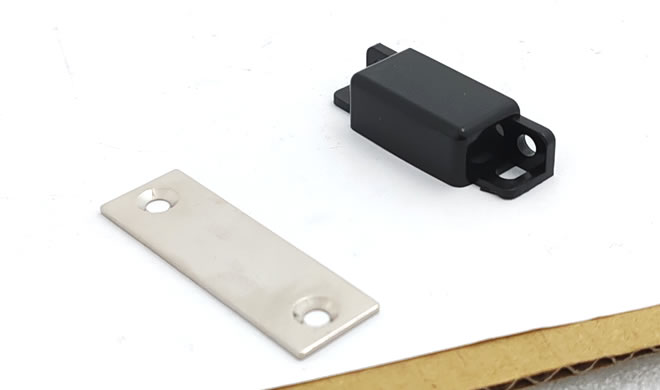
Magnetic catches rely on an internal permanent magnet to generate the holding force used for positioning and latching cabinet doors, equipment covers, and enclosures. Under normal conditions, a permanent magnet retains its magnetic performance for a long time, but in certain environments and under specific usage conditions the effective holding force can decline over time. It is important to note that a perceived "loss of magnetism" does not necessarily mean the magnet itself has demagnetized. An increased gap between the magnet and the strike plate, contamination on the contact surface, or deformation of the mounting structure can all reduce the actual holding force. When troubleshooting a weak magnetic catch, the first step is to separate two distinct problems: true magnet demagnetization versus a change in the actual holding conditions.
1. Temperature Is a Major Factor
High temperature is one of the most significant causes of change in a permanent magnet's performance. Different magnet materials have different temperature tolerances. When a magnetic catch is operated for long periods in a high-temperature environment, the magnet's magnetic properties may change, and the risk of irreversible demagnetization rises once certain temperature thresholds are exceeded. If the catch is mounted near motors, heating equipment, or high-temperature process zones, confirm the working temperature range of the magnet material itself — do not judge heat resistance by the catch's outer housing alone. For ordinary industrial environments, temperature is usually not a visible problem; but in sustained high-temperature conditions, magnet material selection directly determines long-term stability.
2. Magnet Material Affects Demagnetization Resistance
Permanent magnet materials differ in magnetic performance and environmental durability. Common types include neodymium (NdFeB), ferrite (ceramic), and other magnetic materials, each with distinct characteristics in energy product, temperature resistance, and demagnetization resistance.
| Material | Magnetic strength | Max operating temp* | Stability / notes |
|---|---|---|---|
| Neodymium (NdFeB) | High — highest energy product | Grade-dependent, ~80 °C (std) up to 230 °C (high-temp grades) | Strongest pull; must match grade to temperature |
| Ferrite (ceramic) | Moderate | Higher intrinsic tolerance, ~250 °C class | Lower pull but good thermal and corrosion stability, lower cost |
*Actual limit depends on the specific grade (see the temperature-rating table below).
Therefore, "the stronger the magnetism, the better" is not a sound selection rule. For long-service equipment, choose the magnet material and grade based on temperature, environment, and the required holding force.
| Magnet / grade | Typical max operating temp | When to use |
|---|---|---|
| NdFeB — N | ~80 °C | Room-temp indoor enclosures, no heat source nearby |
| NdFeB — M | ~100 °C | Mildly warm cabinets, occasional proximity to equipment |
| NdFeB — H | ~120 °C | General industrial, near warm components |
| NdFeB — SH | ~150 °C | Heated zones, lighting ballasts, motor-adjacent |
| NdFeB — UH | ~180 °C | Sustained warm process areas |
| NdFeB — EH | ~200 °C | High-temp duty, verified by supplier data |
| NdFeB — TH | ~230 °C | Extreme high-temp, case-by-case validation |
| Ferrite (ceramic) | ~250 °C class | High-temp + cost-sensitive, where lower pull is acceptable |
*Values are typical; always confirm the exact rating on the supplier's material datasheet, since tolerances vary by manufacturer.
3. External Magnetic Fields Can Affect Magnet State
If a magnetic catch is placed for long periods in a strong external magnetic field, its magnetization state may also change. Near motors, transformers, electromagnets, and similar equipment, confirm whether the installation position and field strength could affect the magnet. Weak fields from ordinary office furniture, enclosures, and general machinery typically cause no noticeable demagnetization, but special industrial equipment should not be specified using ordinary-environment assumptions.
4. Mechanical Shock and Vibration Should Not Be Ignored
Strong shock and vibration during assembly, transport, or long-term operation can also affect the magnet and internal structure. If the magnet cracks, the mounting loosens, or the magnet collides abnormally with the housing, the catch's apparent holding force may change. In addition, with frequent door cycling, if every closing impact is large, wear on the mechanical structure and contact face can accelerate. For high-cycle equipment, avoid relying on the magnetic catch to absorb unnecessary shock loads during positioning.
5. Air Gap Makes the Force Appear to Drop Sharply
This is one of the most common real-world causes and is easily mistaken for "magnet demagnetization." The actual holding force of a magnetic catch is highly sensitive to the distance between the magnet and the strike plate. If the door deforms, the mounting shifts, or the contact face gains coating, dust, or metal chips that prevent full contact, the holding effect drops markedly. So when a catch seems weak, first inspect the gap, contact condition, and mounting position. If the magnet's magnetism is essentially unchanged and the force recovers after realigning the installation, the problem lies in the holding conditions, not in demagnetization.
6. Corrosion and Surface Treatment Affect Long-Term Use
In humid, salt-spray, or corrosive environments, the housing, magnet, and internal metal parts can all corrode. Once the magnet's protective coating is breached, corrosion can progress inward and eventually compromise magnet integrity and performance. For outdoor equipment, food machinery, humid areas, and corrosive environments, confirm that the magnet protection and housing material meet the actual duty requirements.
7. How to Tell True Demagnetization from an Installation Problem
If holding force drops after a period of use, first check the contact face for gaps, misalignment, or contamination, then check whether the door or cover has deformed. If the mounting is normal, look for abnormal conditions such as high temperature, strong fields, severe shock, or corrosion. For fleet equipment, compare an older catch against a new one in a direct holding-force test. If only catches at specific positions or under specific duty show problems, focus the investigation on that location's temperature, vibration, and mounting conditions.
8. Quick Diagnostic Table — Weak Holding Force
| Symptom | Likely cause | Corrective action |
|---|---|---|
| Door won't stay latched | Air gap too large / misalignment | Realign strike plate; reduce gap to spec |
| Force dropped after moving near a motor | External field or elevated temperature | Relocate away from source; verify field/temp |
| Weak at one unit only | Contamination or local door deformation | Clean contact face; check door flatness |
| Progressive loss over months in a hot area | Thermal demagnetization | Switch to a higher-temp magnet grade |
| Rust / corrosion on housing | Harsh environment | Upgrade to stainless / better coating |
| Intermittent hold, rattling | Shock/vibration loosening the mount | Secure screws; add thread-locker / damper |
9. Purchasing Advice
When procuring magnetic catches, specify the required holding force, magnet material, operating temperature, mounting dimensions, air gap, and environmental conditions. For industrial enclosures or equipment covers, also consider door weight, opening frequency, and closing impact. For high-temperature, humid, or outdoor use, prioritize magnet material and protection performance. Finally, do not select purely by nominal pull force — the actual holding force is also affected by the strike-plate material, contact area, and gap, so validate against the real installation where possible.
10. Selection Checklist
Defined required holding force (with safety margin for vibration).
Magnet material and grade matched to the maximum local temperature, not the average.
Strike-plate material and contact area confirmed (steel gives the best pull).
Expected air gap in the closed position within the catch's rated range.
Environment classified: indoor / humid / salt-spray / corrosive / outdoor.
Door weight, opening frequency, and closing-impact load reviewed.
External magnetic-field sources (motors, transformers) checked and clearance verified.
Corrosion protection (coating / housing material) adequate for the duty.
Sample validated on the actual installation before fleet rollout.
11. Common Misconceptions
Misconception 1: "A magnetic catch will inevitably demagnetize over time." Not necessarily. Permanent magnets are generally stable long-term; apparent loss often comes from gaps, contamination, or deformation.
Misconception 2: "The stronger the magnet, the more durable the catch." Pull strength and demagnetization resistance are different properties; material, temperature, and environment matter more.
Misconception 3: "High temperature only affects the housing." High temperature can also affect the internal permanent magnet, depending on its material and operating temperature.
Misconception 4: "Replace the catch as soon as force drops." First check the air gap, mounting position, door deformation, and contact-face contamination to avoid misdiagnosing an installation issue as demagnetization.
12. FAQ
Q: Why does a magnetic catch seem to lose magnetism with use?
A: It may relate to high temperature, strong external fields, mechanical shock, or corrosion — or it may simply be an increased air gap reducing the actual force.
Q: Do magnetic catches naturally demagnetize?
A: In normal environments, permanent magnets are generally stable long-term, and natural demagnetization is usually very slow.
Q: Can high temperature demagnetize a catch?
A: Yes. Above the magnet's applicable temperature, performance can change irreversibly, depending on material and grade.
Q: Is a drop in holding force always demagnetization?
A: No. Increased gap, surface contamination, mounting offset, and door deformation can all reduce force.
Q: How can I reduce holding-force loss?
A: Avoid sustained over-temperature and strong-field exposure, minimize severe mechanical shock, and select the right magnet material and protection for the actual environment.
Copyright © 2016-2025 Forrun (Guangdong) Industrial Technology Co., Ltd All Rights Reserved.


