- Contact Us
- -
- Payment
- -
- 中文版
Knowledge Center · 2026-10-12 09:39:15 · 34 hits
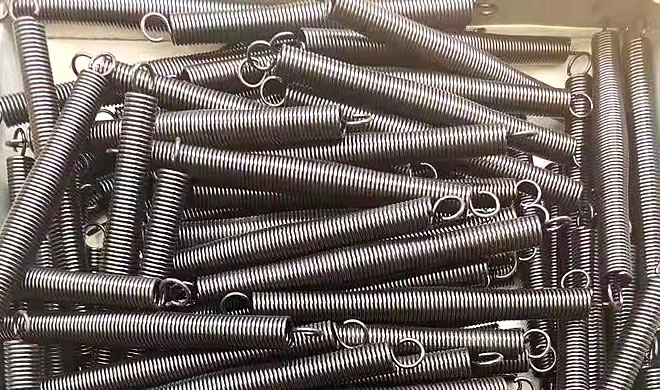
1. Extension Springs in Industry
An extension spring stores and releases energy through the elastic behavior of its material while it is in tension. It is a standard component across automation equipment, door and gate systems, household appliances, automotive structures, and agricultural machinery. In these environments the spring must not only deliver a stable pulling force — it must hold that performance over the long term, without loss of force or deformation, across the range of temperatures the machine actually sees.
Extension springs differ from compression springs in one important way: they are wound with initial tension, meaning the coils already press together inside the body. The spring therefore produces no external force until it is stretched beyond that initial tension, after which it behaves linearly:
F = k · (x − x₀)
where F = applied force, k = spring rate, x = total extension, and x₀ = initial-tension take-up.
When specifying an extension spring, always ask the supplier for the initial tension value as well as the free length and spring rate — it directly affects the force you feel at the start of travel.
2. Working Temperature Range by Material
The service temperature of an extension spring is set mainly by its material. The table below lists typical ranges for common spring materials.
| Material (typical grade) | Service temperature | Characteristics | Typical use |
|---|---|---|---|
| Carbon spring steel (e.g. 65Mn / SAE 1080, chrome-silicon variants) | −20 °C to +120 °C | Low cost, good elasticity, moderate heat and corrosion resistance | General machinery at room temperature, cost-sensitive duty |
| Stainless spring steel 304 (SUS304) | −60 °C to +250 °C | Good corrosion resistance, good heat resistance | Humid, high-temperature, mildly corrosive environments |
| Stainless spring steel 316 (SUS316) | −60 °C to +300 °C | Better corrosion resistance than 304, especially against chlorides and acids | Food machinery, chemical duty, coastal sites |
| Heat-resistant alloy (e.g. Inconel X-750) | −200 °C to +400 °C and above | Retains mechanical properties at very high temperature and in aggressive media | Aerospace, nuclear equipment, high-temperature furnaces |
| Music wire / oil-tempered wire (high-carbon) | Roughly −20 °C to +100 °C | Very high strength, low cost, limited temperature and corrosion capability | High-force, room-temperature applications |
Editor's note on notation: "SUS" is a Japanese Industrial Standard (JIS) designation. On English-language catalogues these are commonly written as 304 SS and 316 SS; both notations appear in the same part number in many supplier listings. When ordering, give the material in the notation the supplier uses to avoid ambiguity.
Important: the temperature limits above refer to the material. Because every spring also carries stress, the practical limit is usually lower than the bulk material figure — a spring under load will lose force and permanent-set earlier than an unstressed part of the same alloy. Always derate for the working stress (see Section 5).
2.1 Quick Material Selection by Temperature Band
| Service temperature (actual operating range) | Recommended material | Remarks |
|---|---|---|
| Room temperature, dry, indoor (−20 to +100 °C) | Carbon spring steel (65Mn / oil-tempered) | Lowest cost; needs plating if humidity is present |
| −20 to +120 °C, general machinery | Carbon spring steel + bluing / zinc plating | Watch relaxation above ~100 °C |
| −60 to +250 °C, humid or mildly corrosive | 304 SS (SUS304) | Default choice for outdoor door/gate systems |
| −60 to +300 °C, food, chemical, coastal | 316 SS (SUS316) | Better chloride and acid resistance |
| Below −60 °C (cold regions) | Low-temperature austenitic stainless | Retains ductility; never use carbon steel |
| +300 °C and above, sustained | Inconel X-750 or similar nickel alloy | Furnaces, aerospace, nuclear |
3. What to Watch at High and Low Temperature
3.1 Loss of Elasticity at High Temperature
Sustained exposure to high temperature reduces the material's restoring (relaxation) stress, leading to weaker pull force and eventual permanent set. This is why heat-resistant material must be specified for hot-duty springs rather than relying on a stronger wire diameter.
3.2 Increased Brittleness at Low Temperature
Some spring materials become brittle and can crack in cold conditions. Avoid carbon steel in extreme cold — switch to an austenitic stainless steel, which retains ductility well below freezing.
3.3 Prevent Thermal Fatigue and Oxidation Corrosion
Springs running in hot or humid environments should receive surface protection — bluing / black oxide, coating, or plating — or be built from a stainless series, depending on the media and the required service life.
3.4 Thermal Cycling
Repeated heating and cooling expands and contracts the wire and can relax the coating or the set of the spring. Where the duty involves frequent thermal cycles, choose a material with low thermal-expansion mismatch at the mounting points and validate by life testing.
4. Spring Rate and Wire Diameter Sizing
Spring rate is set by the material's shear modulus G and the spring geometry — wire diameter d, mean coil diameter D, and number of active coils n:
k = G · d⁴ / (8 · D³ · n) (N/mm, with mm units)
Two springs of the same material can therefore have very different rates purely from geometry. Use this to tune force without changing material — a larger coil diameter D lowers the rate sharply (cubic), while a larger wire d raises it sharply (fourth power).
Worked Example
Design a spring for a door-control linkage: target ≈ 30 N of pull at 10 mm of working travel.
Material: carbon spring steel → G ≈ 79,300 N/mm².
Selected geometry: wire d = 1.0 mm, mean coil diameter D = 6 mm, active coils n = 20.
k = 79,300 × 1.0⁴ / (8 × 6³ × 20) = 79,300 / 34,560 ≈ 2.3 N/mm
Force at 10 mm extension ≈ 2.3 × 10 = 23 N (before subtracting initial tension)
Recheck the geometry or coil count until the rate delivers the required force; remember to subtract the supplier's initial-tension value from the usable force.
Tip: if the rate is too high, increase D or n before changing the material — you keep the force characteristic but reduce stress and improve fatigue life.
5. Allowable Stress, Temperature Derating and Permanent-Set Check
The spring's life and its resistance to permanent set are governed by the torsional stress in the wire:
τ = 8 · F · D · K_w / (π · d³)
where K_w ≈ 1.2 (stress concentration at the coil), F = working force, D = mean coil diameter, d = wire diameter.
Allowable torsion stress is roughly 0.45 × tensile strength at room temperature — and it drops as the spring gets hotter.
5.1 Temperature Derating of Allowable Stress (typical)
| Operating temperature | Allowable stress (vs room-temperature value) |
|---|---|
| ≤ 20 °C | 100% |
| 100 °C | ~90% |
| 150 °C | ~80% |
| 200 °C | ~70% |
| 250 °C | ~60% |
| 300 °C | ~50% |
Typical reference curve for carbon and stainless spring steels; use the supplier's data for the actual grade.
5.2 Worked Check with Temperature
Continuing the Section 4 example (d = 1.0 mm, D = 6 mm, K_w = 1.2), at a working force of 23 N:
τ = 8 × 23 × 6 × 1.2 / (π × 1.0³) ≈ 422 MPa
Music wire / oil-tempered wire (tensile ~1,700 MPa) → allowable ≈ 0.45 × 1,700 ≈ 765 MPa → passes at room temperature and remains safe to ~200 °C.
Convertible limit: allowable force at temperature is
F_allow = τ_allow × π × d³ / (8 · D · K_w)
– At 20 °C (τ = 765 MPa): F_allow ≈ 765 × 3.14 /(8 × 6 × 1.2) ≈ 41.8 N
– At 150 °C, derated to ~80% (τ = 612 MPa): F_allow ≈ 33.4 N
– At 300 °C, derated to ~50% (τ = 383 MPa): F_allow ≈ 20.9 N
Maximum safe extension = (F_allow − F_initial tension) / k. With an initial tension of ~5 N:
– At room temperature: (41.8 − 5)/2.3 ≈ 16 mm
– At 150 °C: (33.4 − 5)/2.3 ≈ 12 mm
– At 300 °C: (20.9 − 5)/2.3 ≈ 7 mm
Takeaway: temperature does not just weaken the material — it shortens the usable travel. If your application needs 12 mm of travel at 150 °C, this spring is at its limit; increase the wire diameter or switch to a heat-resistant alloy.
6. Other Key Selection Parameters
Temperature is often the deciding factor, but a correct selection also needs these checks:
| Parameter | What to confirm | Why it matters |
|---|---|---|
| Spring rate k | Force per unit extension (F = k·x) | Sets the pull characteristic |
| Initial tension | Force required before the spring starts to pull | Affects the start of travel and linkage geometry |
| Free length | Unstretched length | Must fit the installed space |
| Max extension | Safe working travel before solid or yield | Prevents permanent deformation |
| Allowable stress | Working stress vs material limit | Determines fatigue and relaxation life |
| Surface treatment | Bluing / plating / coating / epoxy | Corrosion and wear life |
| End type | Loop, extended hook, cross-over hook, swivel hook | How the spring anchors to the load |
7. Selection Examples by Scenario
| Recommended material | Reason | |
|---|---|---|
| Outdoor door / gate systems | 304 SS (SUS304) | Corrosion resistant; handles daily temperature swings |
| Food machinery | 316 SS (SUS316) | Meets high-temperature and food-contact safety requirements |
| High-temperature industrial furnace equipment | Inconel alloy (e.g. X-750) | Maintains strength and elasticity at sustained high temperature |
| Automation equipment in cold regions | Low-temperature-grade austenitic stainless (ductile below −60 °C) | Retains ductility in sub-zero ambient |
For outdoor door and gate systems, also consider salt / road-de-icing exposure and choose 316 SS for coastal or winter-service sites.
8. Installation and Maintenance
8.1 Installation
Keep the load axis aligned with the spring axis — side load on a hook concentrates stress at the bend and causes early breakage.
Avoid sharp bend radii at hooks and loops; prefer generous radii or swivel hooks for misaligned anchors.
Do not stretch a spring beyond its maximum extension at assembly; fit a mechanical stop on the linkage if travel cannot be limited.
Protect hooks and the free length from contact with moving parts, edges, and pinch points.
8.2 Maintenance
Periodic visual inspection: look for elongation, surface pitting/rust, and crack-like lines at the hook bend.
Keep the area clean and dry; where the design allows, apply a light corrosion-preventive oil (not on food-contact springs unless it is a food-grade lubricant).
Track service hours / cycle count on high-duty springs and replace on schedule rather than after failure.
Replace as a matched pair where two springs share a load, so forces stay balanced.
9. Common Issues
| ssue | Likely cause | Corrective action |
|---|---|---|
| Spring loses force over time in a hot area | Stress relaxation from high temperature | Use heat-resistant alloy; dererate load and travel |
| Permanent elongation / set | Exceeded max extension or allowable stress | Shorten travel; increase wire diameter or switch material |
| Cracking in winter operation | Carbon steel at low temperature | Switch to austenitic stainless |
| Breakage at the hook bend | Sharp bend radius, side load, fatigue | Larger bend radius; align the axis; use a swivel hook |
| Surface rust | No coating or wrong coating for the environment | Bluing / plating / coating, or stainless grade |
| Coating flaking / spring sticking | Thermal cycling beyond coating tolerance | Use a grade-rated coating or stainless; limit cycling |
| No force at the start of travel | Initial-tension take-up not accounted for | Add the initial-tension value into the linkage design |
| Uneven force between two springs | Individually wound tolerances, asymmetric pre-load | Install as a matched set; pre-tension equally |
| Slack / loose coils at the end | Hook deformation or over-stretched free length | Replace; check the fixed anchor point |
10. Selection Checklist
Defined required pull force at the target extension (use F = k·x).
Confirmed the minimum and maximum service temperature, not just the average.
Matched material to temperature, humidity and corrosiveness.
Chose a grade with ductility below the lowest ambient temperature.
Sized the wire diameter / coil diameter so τ stays within the temperature-derated allowable.
Verified free length, diameters and max extension fit the installation.
Computed the maximum safe travel at the hottest operating temperature.
Specified surface treatment (bluing / coating / plating) for the environment.
Checked allowable stress and expected cycle life.
Confirmed end type, initial tension, and axis alignment for the mounting.
11. FAQ
Q: Can I use a carbon-steel spring outdoors?
A: Only with effective plating or coating and in mild climates. For permanent outdoor exposure, 304 SS or 316 SS is the safer choice.
Q: Why does my spring feel weaker than the catalogue rating?
A: Two common reasons: the operating temperature is above the rating, relaxing the stress; or the installed extension is below the initial tension, so you are measuring the take-up rather than the working force.
Q: Is 316 always better than 304?
A: For corrosion it is, particularly against chlorides. It is also more expensive and slightly lower in strength — choose it where the environment genuinely demands it.
Q: How do I extend service life in a hot machine?
A: Derate the load, shorten the operating travel, move the spring away from the direct heat source, and specify a heat-resistant alloy such as Inconel X-750 for sustained temperatures above 300 °C.
Q: Can I raise the spring rate by using a thicker wire?
A: Yes — rate scales with the fourth power of wire diameter, so a small increase in d sharply raises the force. The trade-off is higher stress and less flexibility in travel; re-check τ after every change.
Q: Should I replace a spring that still looks fine?
A: On high-cycle or safety-relevant duties, yes — replace on a cycle-count or service-hour basis. Visual inspection misses internal fatigue and stress relaxation until the spring has already set or broken.
Copyright © 2016-2025 Forrun (Guangdong) Industrial Technology Co., Ltd All Rights Reserved.


