- Contact Us
- -
- Payment
- -
- 中文版
Knowledge Center · 2026-10-08 09:31:39 · 12 hits
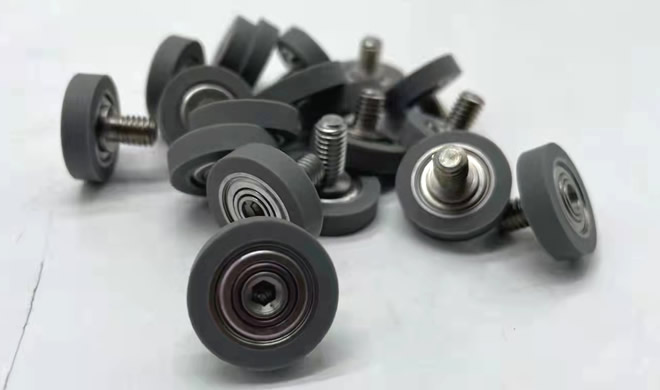
A coated bearing (elastomer-coated bearing) is a bearing whose outer or inner ring is covered with an elastic material such as rubber, TPU, or polyurethane (PU). Compared with a standard metal bearing, a coated bearing offers vibration damping, noise reduction, stronger grip, and a surface that does not mark or damage the workpiece. It is widely used in equipment with special requirements for transmission noise, product protection, and friction control. This article starts from its structural features and systematically introduces typical use cases and suitable duty conditions.
1. Structural Features
1.1 Coating Material
Common materials include nitrile rubber (NBR), polyurethane (PU), and silicone. Different materials differ in hardness, elasticity, and wear resistance, so the choice drives the bearing's behavior in service.
1.2 Coated Location
Outer-ring coated type: Used where the bearing contacts the conveyor belt or the material directly.
Inner-ring coated type: Used where a special mounting method or internal cushioning is required.
1.3 Special Properties
Low-noise operation.
Vibration damping and shock absorption.
Non-marking surface that protects products.
A degree of anti-slip behavior and oil resistance.
2. Typical Applications
| Industry | Primary need | Recommended coating |
|---|---|---|
| Electronics manufacturing | Non-marking, stable run | PU / soft NBR |
| Food conveying | Food-grade, impact cushioning | Silicone (FDA-compliant) |
| Packaging machinery | Grip, anti-slip | PU / NBR |
| Textile machinery | No marking on yarn/spool | PU |
| Medical / pharma | Hygienic, corrosion resistant | Silicone / PU |
| Automation assembly | Cushioning, no metal-to-metal | PU / NBR |
| Glass & ceramic handling | Wear + elastic, no scratch | PU |
Electronics manufacturing: In SMT placement machines and electronic assembly lines, coated bearings convey precision PCBs. The coating avoids scratching the PCB surface and improves running stability and yield.
Food conveying lines: For fragile packages (glass bottles, easily torn bagged food), food-grade silicone-coated bearings safeguard food safety and absorb impact.
Packaging machinery: Flexible clamping/conveying of film and cartons; the coating raises friction to prevent slippage and gives smoother operation.
Textile machinery: During yarn conveying, spool surfaces must be free of burrs and pressure marks; coated bearings provide grip while avoiding material damage.
Medical / pharmaceutical equipment: Automatic conveying of vials, capsule boxes, and IV bags uses corrosion-resistant, high-hygiene coating materials.
Automation assembly lines: Widely used in flexible conveying and positioning devices; coated bearings cushion collisions and avoid direct metal-to-metal contact.
Glass and ceramic handling: Prevents scratching of high-gloss or brittle surfaces; PU coating offers good wear resistance and elasticity.
3. Usage Notes and Selection
3.1 Select Coating Material by Product Characteristics
For oily or corrosion-resistant duty, choose FKM (fluororubber) or PU.
For food contact, use FDA-compliant silicone.
| Material | Hardness (Shore A) | Typical temp range | Key properties | Typical use |
|---|---|---|---|---|
| NBR | 60–90 | ~ -30 to 100 °C | Oil-resistant, economical | Oily / general industrial |
| PU (polyurethane) | 70–95 | ~ -40 to 80 °C (some to ~120 °C) | Wear-resistant, high load, elastic | Glass/ceramic, general conveying |
| Silicone | 30–80 | ~ -60 to 200 °C | Food-grade, heat-tolerant, soft | Food, medical, high temp |
| FKM (Viton) | 60–90 | ~ -20 to 250 °C | Chemical & oil resistant | Harsh chemical / high temp |
*Typical values; confirm exact grade ratings with the supplier.
3.2 Hardness (Shore A) Selection Guide
| Hardness (Shore A) | Behavior | Use |
|---|---|---|
| 30–50 (soft) | Maximum cushioning, low load, high grip | Fragile products, gentle handling |
| 50–70 (medium) | Balanced grip and wear | General conveying, packaging |
| 70–90 (hard) | Higher load, wear-resistant, less cushion | Heavy / abrasive, glass & ceramic |
| >90 (very hard) | Near-rigid, longest wear life | Minimal cushioning required |
3.3 Ensure Uniform, Well-Bonded Coating
Coating delamination (debonding) causes abnormal operation and loss of accuracy — verify bond quality.
3.4 Watch Temperature and Speed Limits
Some rubbers soften, age, or debond under high temperature or high speed; stay within the rated range.
3.5 Choose Coating Thickness Carefully
Set thickness from the required cushioning effect and the dimensional fit of the assembly.
Selection Checklist
Identified the product/contact material and its sensitivity (marking, chemical).
Matched coating material to environment (oil, food, chemical, temp).
Confirmed food/medical duty uses FDA-compliant material.
Selected hardness (Shore A) for the load and cushioning need.
Verified coating is uniform and bonded; checked debonding risk.
Checked temperature and speed limits of the elastomer.
Set coating thickness for the needed cushioning and fit.
4. Coated vs Standard Bearing
| Aspect | Standard bearing | Coated bearing |
|---|---|---|
| Noise | Metal-on-metal, louder | Damped, quieter |
| Product protection | Can mark / scratch | Non-marking |
| Grip / friction | Low (steel surface) | High (elastomer) |
| Shock absorption | Low | Good |
| Load capacity | Higher | Reduced (elastomer limits) |
| Speed / temp limit | Wide | Limited by elastomer |
| Chemical resistance | Depends on ring material | Depends on coating choice |
| Cost | Lower | Higher |
Choose a coated bearing when noise, product protection, or grip dominate; choose a standard bearing when load, speed, or cost dominate.
5. Common Issues
| Issue | Likely cause | Corrective action |
|---|---|---|
| Debonding / coating peel | Poor bond, overload, chemical attack | Improve bond quality; verify rating; replace |
| Flat spot (permanent set) | Long static load, coating too soft | Use harder grade; relieve standing load |
| Premature wear | Abrasive contact, overspeed | Harder grade; check speed limit |
| Swelling / degradation | Incompatible chemical | Switch to FKM / silicone; verify compatibility |
| Overheating | Exceeded temp / speed | Lower speed; choose heat-rated elastomer |
Copyright © 2016-2025 Forrun (Guangdong) Industrial Technology Co., Ltd All Rights Reserved.


