- Contact Us
- -
- Payment
- -
- 中文版
Knowledge Center · 2026-10-21 09:22:44 · 31 hits
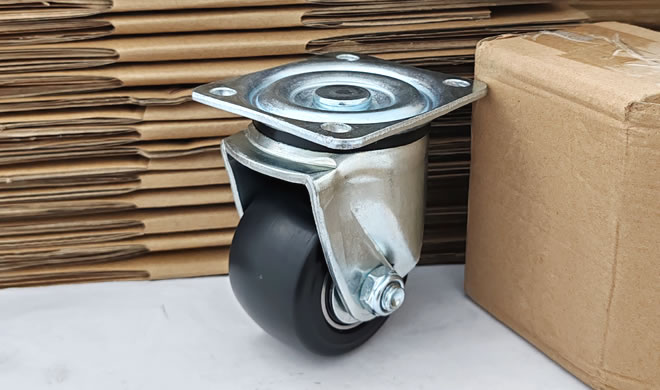
1. Which High-Load Mobile Equipment Suits Heavy-Duty Casters
Heavy-duty casters are best matched to equipment that must be moved as a whole — industrial machinery, production tooling/fixtures, material-handling equipment, and large mobile workstations. Typical examples include large equipment racks and frames, industrial carts, heavy-duty tool carts, mold (die) carts, logistics transfer carts, and the bases of some automation equipment, all of which may rely on heavy-duty casters for position adjustment or short-distance transport.
Such equipment is usually characterized by high weight, a low to medium move frequency, and a need for high load stability — ordinary light-duty casters generally fail to meet long-term service requirements.
2. Why High-Load Equipment Needs Heavy-Duty Casters
As equipment weight rises, the vertical load on each caster rises accordingly. If the equipment also starts, stops, or turns frequently, the actual dynamic load on the casters increases further. Especially on uneven floors, passing over floor joints, ramps, or obstacles generates instantaneous shock (impact).
When the caster's rated load capacity is insufficient, problems appear quickly: wheel-tread deformation, yoke/bracket bending, and swivel-mechanism damage. Therefore a heavy-duty caster does more than "carry more weight" — it must also guarantee stability throughout the moving process.
Note: Always size casters for the dynamic (moving) condition, not just the static weight. A common rule of thumb is to apply a safety factor of 1.3–1.5× to the static per-caster load when movement involves start/stop, turning, or rough floors.
3. Different Mobile Equipment Place Different Demands
Heavy logistics & transfer carts — focus on load capacity, rolling resistance, and move frequency. If direction changes are frequent, swivel-caster rotational flexibility becomes critical.
Large equipment & racks — move frequency may be low, but weight and center of gravity (CG) are high; priority goes to load capacity, mounting strength, and post-move stability.
Mold carts & tooling carts — beyond weight, consider whether the load is concentrated and whether impact occurs during movement. With a locally concentrated load, the actual load on a single caster can be far above the simple average.
4. Floor Conditions Affect Caster Selection
The same heavy-duty caster performs very differently on different floors.
| Wheel tread | Best floor | Trade-offs |
|---|---|---|
| Steel / hard tread | Flat, hard industrial floor | High load capacity; more noise; higher point pressure on floor |
| Elastic (rubber / polyurethane) | Floor-protection scenarios | Better shock absorption & noise reduction; gentler on floor |
If the equipment must cross floor seams, ramps, or minor obstacles, wheel diameter and tread material must be considered together — rated load alone is not enough. A larger wheel diameter rolls over gaps and small obstacles more easily and reduces rolling resistance.
5. Common Misconceptions
| Misconception | Reality |
|---|---|
| "Caster capacity = total weight ÷ number of casters." | Due to floor flatness, CG offset, and mounting errors, casters do not always share load equally. |
| "Rated load is all that matters." | The mounting bracket/plate and equipment base must also be rigid enough — insufficient structure causes deformation or loosening even with capable casters. |
6. FAQ
Q: Which equipment mainly suits heavy-duty casters? Large industrial equipment, heavy logistics carts, tooling carts, mold carts, equipment racks, and large mobile workstations — i.e., high-load mobile equipment.
Q: Is a higher load rating always better? No. Select based on actual load and operating conditions; oversizing raises cost, installation space, and rolling resistance.
Q: How should caster capacity be calculated? Do not simply average the total weight. Account for CG offset, floor condition, impact, and the actual number of casters sharing the load.
Q: Why consider wheel diameter for high-load equipment? A larger diameter more easily clears floor seams and minor obstacles and lowers rolling resistance — but it must fit the available installation space.
Q: Are heavy-duty casters suitable for automation equipment? Yes, for units that need whole-body movement or position adjustment — but also confirm CG, fixing method, move frequency, and post-stop stability.
7. Calculating the Actual Load on a Single Caster
The average formula W / n is only a starting point. In practice the real load on the worst-positioned caster is higher because of CG offset and dynamic events.
Step 1 — static load with CG offset. Model the equipment as a rigid load on n casters. With the CG offset along one axis, the far casters carry more:
F_static ≈ (W / n) × (1 + k)
where k is a practical offset/inclination factor — typically 0.25–0.50 for a moderately off-center CG or slight floor slope.
Step 2 — effective casters during a dynamic event. When one wheel crosses a seam or obstacle it may lift, so only the remaining casters share the load. Use the effective count n_eff (e.g., 3 instead of 4).
Step 3 — apply the dynamic safety factor. Multiply by SF = 1.3–1.5 for start/stop, turning, or rough floors.
F_caster = (W / n_eff) × (1 + k) × SF
Worked example. Equipment weight W = 2000 kg (≈ 19.6 kN), 4 casters, CG moderately offset (k = 0.25), one wheel lifts over a seam (n_eff = 3), SF = 1.5.
F_caster = (2000 / 3) × (1 + 0.25) × 1.5 = 666.7 × 1.25 × 1.5 ≈ 1250 kg per worst caster
So each caster should be rated for at least ~1.3 t (add margin beyond the 1.25 t computed value). Note how far this is from the naive 500 kg average — that gap is exactly why undersized casters fail.
8. Mounting Bracket & Base Strength — Quick Reference
Even a correctly rated caster fails if its attachment is weak. The top plate, bolts, and equipment base must transmit the load without yielding.
| Per-caster load | Recommended bolt (min.) | Top-plate / base plate thickness | Notes |
|---|---|---|---|
| ≤ 0.5 t | M8, 4 pcs | ≥ 4 mm steel | Standard duty |
| 0.5 – 1 t | M10, 4 pcs | ≥ 6 mm steel | Verify base rigidity |
| 1 – 2 t | M12, 4 pcs | ≥ 8 mm steel | Use washer under head |
| > 2 t | M16+, 4–6 pcs | ≥ 10 mm steel | Weld or reinforce base |
Practical rules: use grade 8.8 (or A2-70 stainless) bolts; tighten to the specified torque; ensure the equipment base is flat and locally reinforced around each mounting point — a thin or flexible base plate lets the caster "rock" and loosens fasteners.
9. Three-Way Selection: Load × Wheel Diameter × Floor
| Load per caster | Floor condition | Recommended wheel diameter | Tread choice |
|---|---|---|---|
| ≤ 0.5 t | Smooth / hard | 100 – 125 mm | Steel or hard PU |
| ≤ 0.5 t | Uneven / protective | 125 – 150 mm | Elastic PU / rubber |
| 0.5 – 1.5 t | Smooth / hard | 150 – 200 mm | Steel or forged PU |
| 0.5 – 1.5 t | Uneven / obstacles | 200 – 250 mm | Elastic PU (shock-absorbing) |
| > 1.5 t | Any | 250 mm+ | Forged steel / heavy PU; confirm bracket |
Rule of thumb: raise the wheel diameter one step whenever the floor has seams, ramps, or debris; choose an elastic tread when floor protection or noise matters; choose steel when maximum load and durability dominate.
Copyright © 2016-2025 Forrun (Guangdong) Industrial Technology Co., Ltd All Rights Reserved.


