- Contact Us
- -
- Payment
- -
- 中文版
Knowledge Center · 2026-11-09 10:27:59 · 17 hits
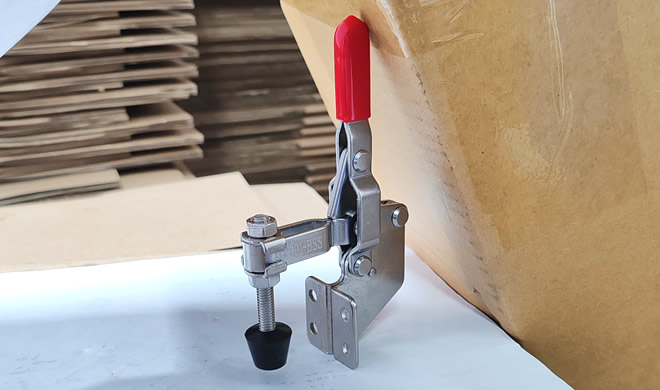
1. Basic Concept and Classification
A clamp or gripper is a common actuating element in automation equipment, used to grasp, fix, or transfer a workpiece. By structure and drive method it is divided into mechanical (toggle) clamps, pneumatic grippers, electric grippers, and hydraulic clamps. Selecting the right type ensures gripping stability, assembly accuracy, and equipment efficiency. (In this context "quick-action clamp/gripper" refers to the fast-cycling gripping elements used throughout automated lines.)
2. Application Scenarios
Assembly station clamping. Holds parts precisely during assembly, ensuring accuracy and repeatability.
Handling and transfer. On conveyor or transfer systems, the gripper securely picks and stably moves the workpiece.
Inspection and machining stations. Fixes the workpiece so its position does not shift during machining or measurement.
3. Selection and Gripping Analysis
3.1 Gripping-force calculation
Determine the required gripping force from the workpiece weight, the friction coefficient, and the process requirement — too little and the part slips; too much and the part or the gripper is damaged. For a two-jaw friction grip holding a part vertically:
F_g ≥ (m · g · SF) / μ
where F_g is the total gripping (clamping) force, m the workpiece mass, g ≈ 9.81 m/s², μ the coefficient of friction between jaw and part, and SF a safety factor (commonly 2–4 for vertical handling, higher with acceleration). Size the gripper so its rated force exceeds F_g with margin.
3.2 Choosing the gripping method
| Method | Motion | Best for |
|---|---|---|
| Parallel | Jaws move parallel | Box-like parts, varying sizes |
| Angular | Jaws pivot in | Tight spaces, top-entry access |
| 3-jaw / concentric | Radial, self-centering | Round parts, centering |
| Custom (shaped jaws) | Dedicated profile | Special geometries |
3.3 Matching the drive method
| Drive | Force | Speed | Precision | Best for |
|---|---|---|---|---|
| Mechanical (toggle) | High, manual | Manual | Low | Fixtures, manual clamping |
| Pneumatic | Medium–high | High (fast cycling) | Moderate | High-speed, light–medium load |
| Electric (servo) | Medium | Moderate | High (adjustable force) | Precise positioning, force control |
| Hydraulic | Very high | Moderate | Moderate | Heavy-load workpieces |
4. Practical Notes
Material and wear resistance. High-hardness materials or surface treatments extend gripper life.
Safety and reliability. Ensure anti-slip and anti-drop holding; where failure is costly, add a sensor to monitor the grip state.
Maintenance and adjustment. Periodically inspect springs, cylinders, and the drive system to keep the gripping force stable.
5. Summary
In automation equipment, the gripper/clamp is a key actuating element; its gripping force, gripping method, and drive method directly affect equipment efficiency and product quality. Scientific selection, rational configuration, and standardized maintenance are the core of stable gripping and smooth automated production.
6. FAQ
Q: How do I size gripping force? Use F_g ≥ (m·g·SF)/μ for a two-jaw friction grip, then choose a gripper whose rated force exceeds that with margin.
Q: Pneumatic or electric? Pneumatic for fast, light–medium duty; electric (servo) when you need adjustable force or precise positioning; hydraulic for very heavy loads.
Q: What safety factor should I use? Typically 2–4 for vertical handling, raised for acceleration, shock, or slippery surfaces.
Q: How do I prevent the part from slipping? Use higher friction jaw faces, increase gripping force within the part's limit, or add a conforming jaw profile; monitor with a sensor for critical parts.
Q: Does gripper material matter? Yes — hardened or coated jaws resist wear and improve grip life in high-cycle duty.
Copyright © 2016-2025 Forrun (Guangdong) Industrial Technology Co., Ltd All Rights Reserved.


