- Contact Us
- -
- Payment
- -
- 中文版
Knowledge Center · 2026-11-10 09:30:02 · 18 hits
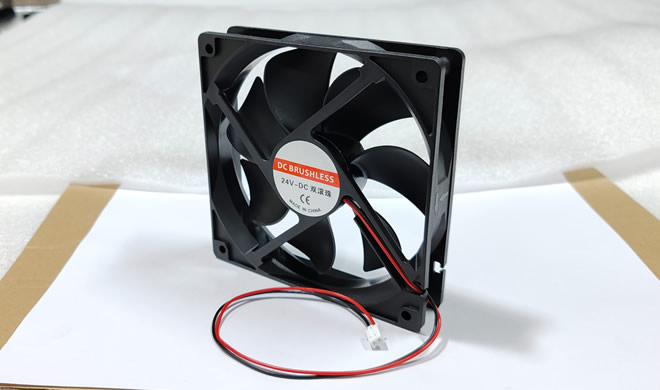
1. Definition Overview
An axial fan moves air parallel to the axis of its impeller. It is typically built as a circular frame with propeller-style blades, and the airflow direction stays essentially unchanged as it passes through. Axial fans are the standard choice for forced ventilation and cooling inside control cabinets, enclosures, variable-frequency drives (VFDs/inverters), and other industrial equipment.
A general-purpose (comfort) fan refers to the common household or utility fans — pedestal, desk, or workshop circulation fans. Their delivery forms vary and they emphasize coverage and human comfort, suited to space ventilation or everyday cooling. (Technically, most comfort fans are themselves axial propeller types; the meaningful industrial distinction is therefore between industrial axial fans, built for high static pressure and forced cooling through resistance, and centrifugal fans, built for high pressure and ducted directional flow. We contrast them here by duty.)
2. Main Differences
2.1 Working principle. An axial fan's airflow aligns with the impeller axis, ideal for linear delivery inside ducts or equipment. Comfort fans are usually open axial propellers for broad circulation; where higher pressure is needed, centrifugal or mixed-flow designs take over.
2.2 Application environment. Axial fans serve internal ventilation and cooling of industrial control cabinets, server racks, welding machines, and power supplies. Comfort fans target living and working spaces — home cooling, indoor ventilation, workshop air exchange.
2.3 Airflow and pressure. Axial fans develop higher static pressure with a concentrated airstream, pushing air through narrow or high-resistance channels. Comfort fans move large volumes over wide areas at low pressure — inadequate for precision equipment cooling.
2.4 Installation and form factor. Axial fans are compact and embeddable into cabinets or machines. Comfort fans are larger and varied (pedestal, wall, desk), flexible to place but hard to integrate.
2.5 Life and reliability. Axial fans use ball or high-performance sleeve bearings and meet industrial standards for long, continuous running. Comfort fans are designed for periodic use and generally trail in dust, water, and vibration resistance.
Comparison at a glance:
| Aspect | Axial fan | General-purpose / comfort fan |
|---|---|---|
| Airflow direction | Parallel to axis | Mostly axial, open circulation |
| Static pressure | Higher, concentrated | Low |
| Typical use | Cabinet/enclosure cooling | Human comfort, room ventilation |
| Form factor | Compact, embeddable | Larger, free-standing |
| Bearing | Ball / sleeve, continuous-duty | Basic, periodic-duty |
| Protection (IP) | Often IP54/IP65 available | Usually none |
| Continuous running | Yes, industrial-rated | Limited |
3. Typical Use Cases
Axial fan: internal cooling of electrical control cabinets; cooling servo systems or PLC modules; ventilation of industrial power supplies and UPS; straight-line ducted supply; exhausting heat from laser or welding equipment.
General-purpose fan: personal cooling in living spaces; office air circulation; auxiliary ventilation in kitchens or balconies; workshop or warehouse air exchange.
4. Selection Advice
Define the need by scenario:
For internal equipment ventilation or cooling, choose an axial fan — stable pressure and compact build.
For occupant comfort ventilation, a general-purpose fan emphasizing airflow, directional adjustment, and quiet operation is appropriate.
Confirm voltage, current, size, and mounting-hole pattern fit the space.
For industrial use, check bearing type, ingress protection (e.g., IP54/IP65), and continuous-run capability.
5. Conclusion
Axial and general-purpose fans differ fundamentally in design intent and performance. The former concentrates on internal equipment cooling and optimized airflow paths; the latter serves ambient air conditioning. Understanding their structure and scope lets users make sound, economical choices in both industrial and everyday settings.
6. FAQ
Q: Are comfort fans and axial fans the same thing? Most comfort fans are axial propeller types, but industrial axial fans are engineered for higher static pressure and continuous duty — that is the real difference.
Q: When do I need a centrifugal fan instead? When air must be pushed through long ducts or high resistance at controlled pressure; axial fans suit lower-resistance, high-volume cooling.
Q: What IP rating should an industrial fan have? IP54 for basic dust/splash protection; IP65 where washdown or heavy dust is expected.
Q: Ball or sleeve bearing? Ball bearings last longer and handle any orientation and higher temperature; sleeve bearings are quieter and cheaper for lighter duty.
Q: Can a comfort fan cool my control cabinet? Not reliably — its low static pressure cannot drive air through the cabinet's resistance; use an axial fan sized for the enclosure.
Copyright © 2016-2025 Forrun (Guangdong) Industrial Technology Co., Ltd All Rights Reserved.


