- Contact Us
- -
- Payment
- -
- 中文版
Knowledge Center · 2026-07-28 09:50:36 · 218 hits
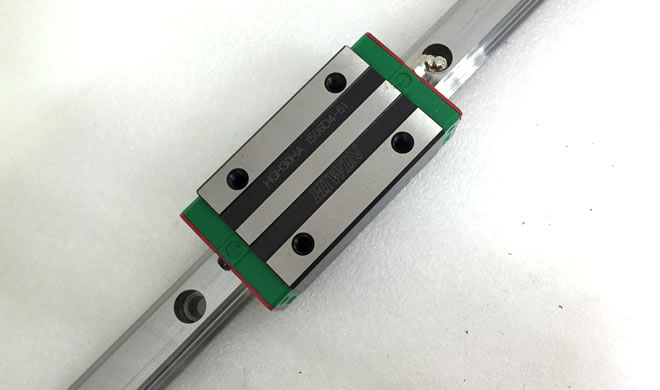
A linear guide, also known as linear rail, is used for high-precision or high-speed linear reciprocating motion. It can withstand certain torque and deliver precise linear motion under heavy loads.
A linear guide mainly consists of a rail and a slider. There are 4 rows of steel balls between the slider and rail (2 rows of steel balls for miniature linear guides). The rolling motion of steel balls enables the slider to travel smoothly along the rail.
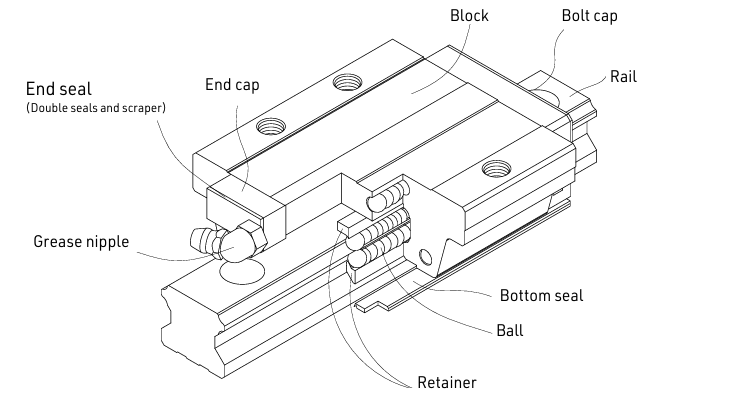
Suitable for reciprocating motion applications and widely adopted across various industries.
(1) Self-aligning capability
(2) High load-carrying capacity
(3) Long service life
(4) High motion accuracy
Linear guides are selected according to operating conditions, expected service life and load capacity:
(1) Define operating conditions
(2) Select model series(
3) Calculate working load
(4) Calculate equivalent load
(5) Verify static safety factor
(6) Evaluate static safety factor
(7) Calculate average load
(8) Check service life
(9) Compare calculated life with required service life
(10) Confirm rigidity performance
(11) Determine accuracy grade
(12) Select lubrication and dust-proof configuration
(13) Complete selection
(1) Before installation, remove burrs and contaminants on the mounting surface using an oil stone or equivalent tools.
(2) Place the rail flat on the reference surface; attach the rail reference edge against the lateral mounting surface.
(3) Fasten the rail onto the reference surface with screws. Do not fully tighten the screws at this stage; ensure screws match the rail mounting holes.
(4) Adjust straightness, then tighten positioning screws of the rail in sequence.
(5) Use a torque wrench to fasten all rail assembly screws sequentially to the specified torque value.
(6) Install matching rails by repeating steps 1 to 5.
(1) Wipe three surfaces of the rail and slider (two side faces + top face) thoroughly with a clean cloth.(2) Apply grease evenly onto the three surfaces of rail and slider using a brush.
Rust FormationCause: The rail substrate has no inherent rust resistance. Rust occurs once the protective oil film on the rail surface is damaged.
Equipment: Mask machine feeding mechanism, mask ear-loop welding mechanism, linear motor, linear moduleDesign Objective: Achieve reciprocating linear movement of workpiecesApplication Description: Used in combination with ball screws, mainly for load bearing.
Copyright © 2016-2025 Forrun (Guangdong) Industrial Technology Co., Ltd All Rights Reserved.


