- Contact Us
- -
- Payment
- -
- 中文版
Knowledge Center · 2026-07-29 13:52:29 · 196 hits
1. Structure of Linear Bearings
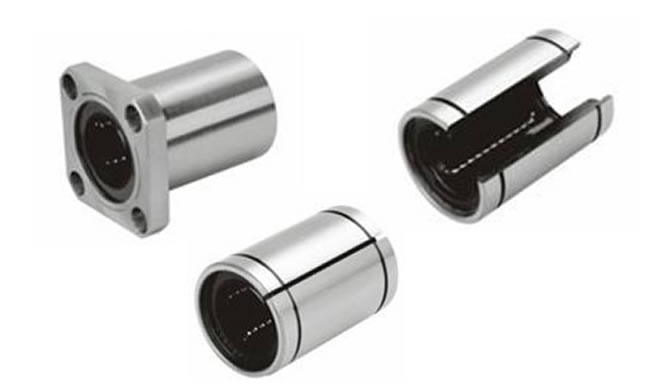
A cylindrical linear bearing generally consists of four main components: outer sleeve, sealing unit, retainer and steel balls.
A flanged linear bearing usually comprises five main components: outer sleeve, sealing unit, retainer, steel balls and flange plate.
2. Introduction to Linear Bearing Retainers
Every type of linear bearing is equipped with a retainer. The linear bearing retainer (also called linear bearing cage) is a core component within linear motion systems. Its structural design directly affects the accuracy, service life and reliability of the entire guiding system.
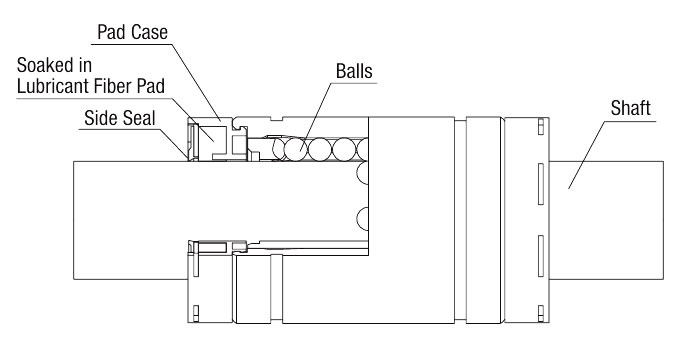
Inside the linear bearing, the retainer precisely positions and guides the steel balls. Specially designed grooves evenly separate the steel balls and confine them within accurate raceway positions, ensuring smooth and orderly rolling of balls inside the bearing circulation path. This evenly distributed structure uniformly shares the applied load among all rows of steel balls, preventing premature component failure caused by localized stress concentration.
3. Material Introduction & Comparison of Retainers
Plastic Resin Retainer
Advantages:
① Lightweight: Resin retainers weigh less than stainless steel retainers, suitable for applications with strict weight limits.
② Low friction: Resin features a low friction coefficient, effectively reducing friction between rolling elements and the retainer to minimize transmission loss.
③ Low noise: The resin material possesses moderate flexibility and favorable lubricating characteristics, generating less operational noise, ideal for low-noise applications.
④ Cost-effective: Resin raw material costs are generally lower than stainless steel; parts are manufactured via injection molding.
⑤ Slow temperature rise during operation.
Disadvantages:
① Limited impact resistance: Resin retainers have low strength and rigidity, not recommended for heavy impact load conditions.
② Poor high-temperature resistance: Certain high-performance resins offer improved heat resistance, but overall resin materials underperform stainless steel at high temperatures and may deform or fail.
③ Inferior wear resistance: Compared with stainless steel, resin has weaker wear resistance. Long-term heavy-load operation may cause retainer deformation or damage.
Stainless Steel Retainer
Advantages:
① High strength: Stainless steel retainers deliver high mechanical strength and rigidity, suitable for heavy-load applications.
② High temperature resistance: Stainless steel maintains stable structure and performance under elevated operating temperatures.
③ Corrosion resistance: Stainless steel provides excellent oxidation and corrosion resistance, performing well in humid and corrosive harsh environments.
Disadvantages:
① Higher friction: Despite good wear resistance, metal retainers have a higher friction coefficient than resin retainers, which may lead to greater friction loss and noise.
② Higher noise level: High hardness of stainless steel tends to generate louder noise during movement, especially under high speed or insufficient lubrication.
③ Higher cost: Stainless steel raw material costs are relatively high, and the stamping manufacturing process is more complex, resulting in higher overall product cost.
④ Fast temperature rise during operation.
4. Selection Guidelines for Linear Bearing Retainers
① Operating Temperature Range
Low-temperature environment (below -15°C): Resin retainers should be avoided, as resin will become brittle at low temperatures. Stainless steel or special steel retainers are recommended, paired with low-temperature grease.
Normal temperature range (0~80°C): Both retainer types are applicable. Selection can be optimized according to other parameters. Friction between resin retainers and steel balls is lower than metal-to-metal contact, delivering quieter operation.
Medium & high-temperature environment (80~120°C): Stainless steel retainers are required. Resin materials are prone to deformation or failure under high temperatures.
② Cost Efficiency
Resin materials are generally cheaper and processed by injection molding.
Stainless steel materials carry higher costs and are formed by stamping.
③ Operating Environment
Stainless steel retainers feature superior oxidation and corrosion resistance with stable performance under humid and corrosive conditions. Choose stainless steel retainers if the working environment involves high humidity or strong corrosive media.
Copyright © 2016-2025 Forrun (Guangdong) Industrial Technology Co., Ltd All Rights Reserved.


