- Contact Us
- -
- Payment
- -
- 中文版
Knowledge Center · 2026-07-30 09:45:14 · 188 hits
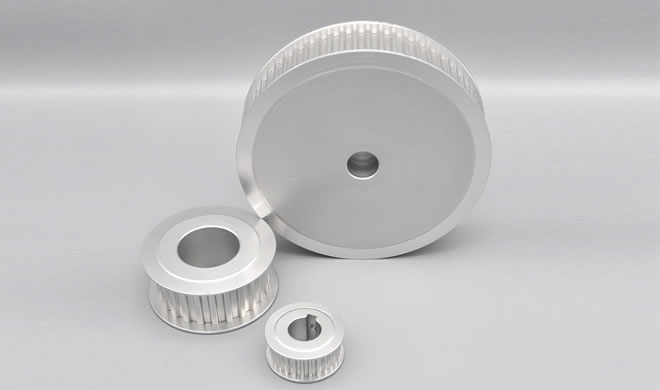
1. Avoid Excessively Small‑Diameter Small Timing Pulley
Given a fixed large‑pulley diameter, reducing the small‑pulley diameter can increase the transmission ratio of the belt drive. However, it reduces the wrap angle on the small pulley. At a given transmitted power, higher effective tension Fis required (‑), which raises the risk of belt slip. Furthermore, a smaller‑diameter pulley increases bending stress on the belt and shortens belt service life.
2. Do Not Use Excessively Small Center Distance between Pulleys
The center distance of a belt drive is generally larger than that of a gear drive. Designers often reduce the center distance for compact layout. Nevertheless, reduced center distance decreases the small‑pulley wrap angle. Therefore, the center distance of belt drives shall be kept within a reasonable range.
3. Belt Speed Shall Be Neither Too Low Nor Too High
With constant transmitted power P, low belt speed v requires large effective tension F according to P=Fv, which demands a large cross‑sectional dimension for the belt. At excessively high belt speed, huge centrifugal force is generated, and the allowable working tension
F becomes very low, leaving little capacity for power transmission. Severe vibration may also occur and cause abnormal operation. Higher speed can be achieved for belts with low mass.
4. Maximize Wrap Angle on the Small Pulley
According to the Euler‑Eytelwein formula for belt friction, under critical slip‑onset conditions, the relationship between tight‑side tension
F1 and slack‑side tension F2 is as follows:
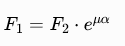
Where:
μ — coefficient of friction between belt and pulley;
α — wrap angle of small pulley;
e — base of natural logarithm.
It is critical to maximize the wrap angle of the small pulley.
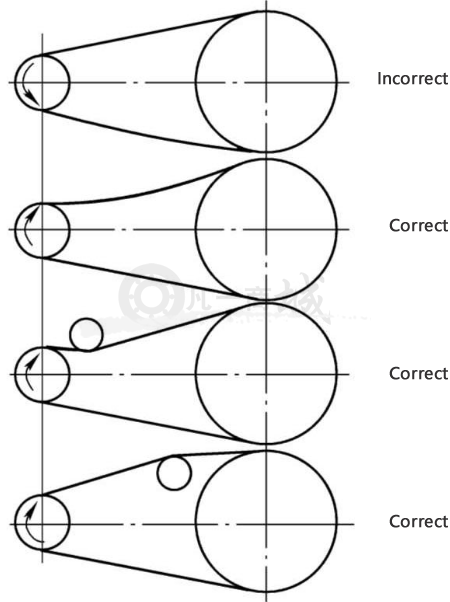
For belt layout, place the tight side at the bottom. The sag of the tight side is minor, while the slack side sags significantly. If the tight side is arranged on top, sagging of the lower slack side reduces the wrap angle of the lower pulley. Proper top‑mounted tight‑side layout can increase wrap angle via slack‑side sag.
Tensioner pulleys shall be mounted on the slack‑side (lower tension). Place it close to the small pulley to increase wrap angle. For outward‑expanding tensioners, mount close to the large pulley, since the large pulley has greater inherent wrap‑angle margin.
5. Optimize Belt Sag to Increase Wrap Angle for Vertically‑Arranged Pulleys
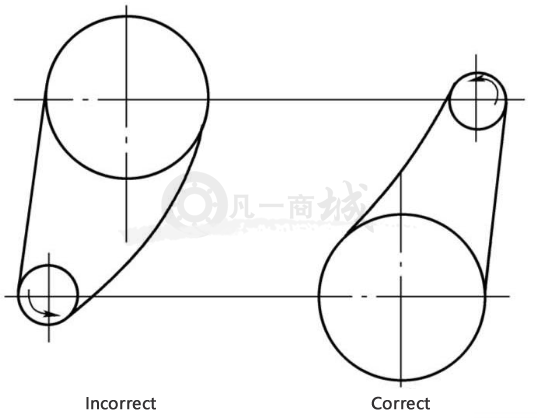
When two parallel pulley shafts are arranged vertically (one above the other), the pulley layout and rotation direction shall be carefully configured. The slack side exhibits larger sag, and such sag shall help increase wrap‑angle on the small pulley.
Due to gravity‑induced belt sag, friction decreases on the lower pulley. A small wrap‑angle on the lower pulley will easily trigger slip; therefore, avoid placing the small pulley at the lower position.
6. Quarter‑Twist Flat‑Belt Drives Cannot Run in Reverse
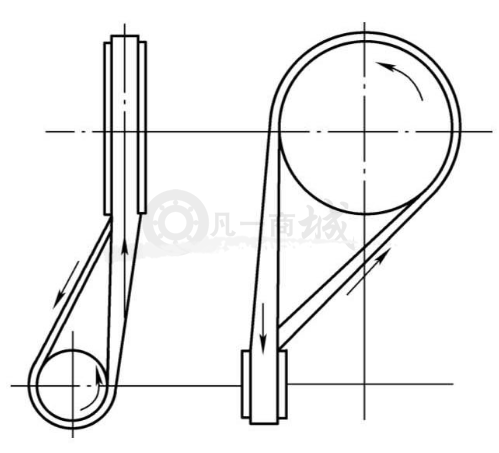
A quarter‑twist drive refers to transmission with spatially staggered shafts (non‑parallel and non‑intersecting), typically at 90°. For stable operation and preventing belt disengagement from pulleys, the centerline of the belt leaving one pulley must align with the central plane of the mating pulley it enters. This type of drive cannot reverse rotation direction.
7. Avoid Overhung‑Mounted Pulleys for Extra‑Wide Belts
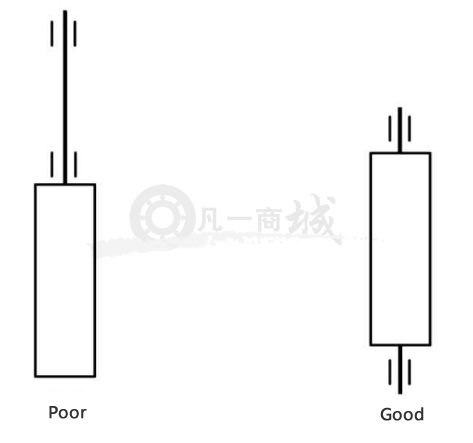
For wide belts, overhung mounting of pulleys causes substantial shaft‑end deflection and pulley misalignment, leading to uneven load distribution across belt width. Switch to simply‑supported mounting configuration.
8. Control Shaft Parallelism and Pulley Coplanarity
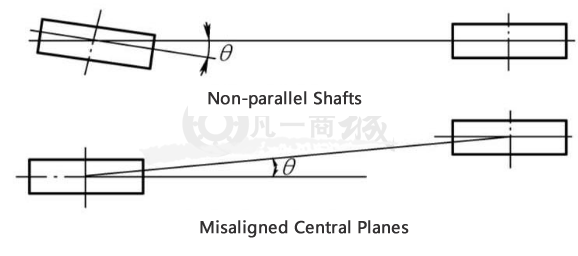
Large misalignment of shaft parallelism or poor coplanarity between pulley central planes will cause the belt to jump off rapidly. Specify and guarantee relevant geometric accuracy in design; provide adjusting mechanisms when necessary. The allowable parallelism error θ for two shafts is within 20 arc‑minutes.
9. Adopt Adjustable Pulley Center Distance
Belt manufacturing has dimensional tolerances; belts also elongate continuously during service. To maintain proper pre‑tension and realize friction‑based power transmission, the pulley center distance shall be adjustable, or auxiliary tensioning devices (e.g. tensioner pulley) shall be equipped.
10. Avoid Excessively Small‑Diameter Tensioner Pulley
A small‑diameter tensioner pulley runs at high rotational speed under given belt velocity, shortening the service life of tensioner bearings. In addition, small‑diameter tensioners impose high bending stress on belts and accelerate belt failure.
Copyright © 2016-2025 Forrun (Guangdong) Industrial Technology Co., Ltd All Rights Reserved.


