- Contact Us
- -
- Payment
- -
- 中文版
Knowledge Center · 2026-08-03 10:19:52 · 111 hits
Preface: Proper shaft‑to‑shaft alignment between motor and coupling is critical for FA automation equipment. Misalignment generates excessive mechanical stress, accelerates component wear, induces vibration and shortens the service life of rotating assemblies. This guideline describes alignment principles, installation notes and two practical inspection‑adjustment methods for on‑site assembly and maintenance.
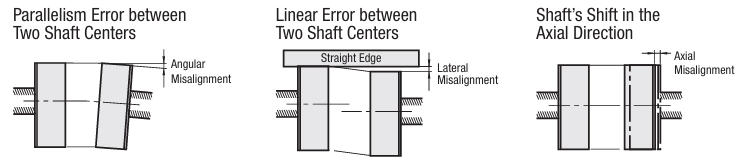
The rotational centers of the two shafts connected by the motor and coupling must be strictly concentric. The coupling shall be accurately aligned during installation. Poor alignment will induce substantial stress on the coupling, severely impair normal operation of shafts, bearings and other shaft‑mounted components. In severe cases, it may cause excessive vibration or even permanent damage to the complete machine and its foundation.
For newly‑installed motors, perpendicularity between the coupling end‑face and shaft axis does not require mandatory inspection. However, when reinstalling a disassembled existing motor, perpendicularity must be carefully checked. If non‑perpendicularity is detected, correct the perpendicularity before performing formal shaft alignment.
During equipment installation, mount the driven machine first and ensure its shaft axis is kept horizontal. Then install the driving unit (motor). Alignment adjustment is completed solely on the driving motor by adding adjustment shims underneath the motor mounting feet.
Two widely‑adopted measurement and alignment methods for maintenance work are listed below:
1.Straight‑edge and feeler gauge method
Measure radial misalignment with a straight‑edge and feeler gauge; measure end‑face parallelism error with a wedge gap gauge or feeler gauge.
Application scope: Suitable for elastically‑coupled equipment operating at low rotating speeds with moderate‑to‑low precision requirements.
2.Dial indicator set‑up method
Measure radial misalignment and face‑run‑out (parallelism deviation) of mating coupling halves using dial indicators with magnetic stands or dedicated shaft‑alignment tools.
Application scope: Recommended for high‑speed rotating equipment, rigid couplings and applications demanding high‑precision alignment.
Copyright © 2016-2025 Forrun (Guangdong) Industrial Technology Co., Ltd All Rights Reserved.


