- Contact Us
- -
- Payment
- -
- 中文版
Knowledge Center · 2026-08-04 10:34:59 · 157 hits
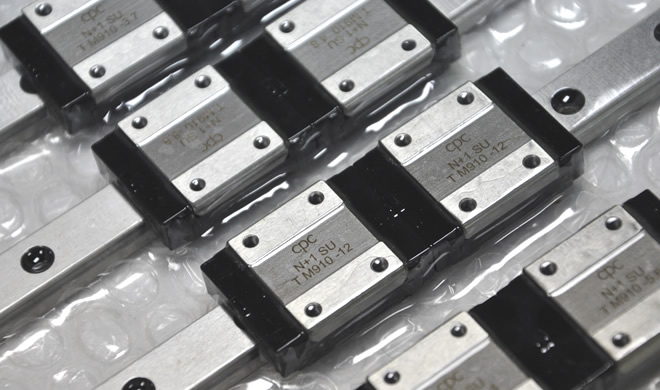
Linear guide preload refers to a preset internal load applied between the carriage and the rail. It maintains steady contact of rolling elements, eliminates internal clearance, and improves motion accuracy and vibration resistance. Different preload classes directly affect motion resistance, rigidity, noise level and service life of linear guides. Therefore, higher preload does not always equal better performance. Engineers shall make comprehensive judgments based on equipment load, precision requirements, operating speed and working environment.
During operation, excessive clearance between carriage and rail will cause tiny displacement of rolling elements under external load or impact, resulting in degraded motion accuracy. Appropriate preload enables tighter contact between rolling elements and raceways, enhancing overall system rigidity and reducing vibration and positioning errors.
Nevertheless, preload increases internal contact stress. Excessively high preload will raise rolling resistance, demand larger driving force, accelerate wear of balls and raceways, and shorten service life.The core principle of preload selection is to achieve optimal balance among rigidity, precision and service life.
General automation machinery, such as transfer mechanisms, assembly equipment and packaging machines, normally does not require high preload. For such equipment prioritizing stable operation and long service life, light preload or standard preload can fully satisfy operating demands.
Excess preload will increase motor load, reduce moving speed and trigger louder operating noise. Blindly adopting high preload is unnecessary for equipment without strict precision positioning requirements.
Precision processing machinery, inspection instruments, semiconductor equipment and high-precision assembly mechanisms impose stringent requirements on guide rigidity and positioning accuracy. Such equipment needs to minimize backlash and suppress external vibration interference, so higher preload classes are commonly selected.
Elevated preload improves the guide’s resistance to load-induced deformation and stabilizes the relative position of carriages during movement, facilitating higher repeat positioning accuracy.It should be noted that high preload brings greater motion resistance. Users must verify whether the drive system can provide sufficient thrust; otherwise, the dynamic performance of equipment will be compromised.
High-speed linear motion mechanisms are highly sensitive to friction resistance and heat accumulation. Excessive preload increases contact pressure between rolling elements and raceways, generating extra frictional heat, which may lead to excessive temperature rise during prolonged high-speed operation.
Accordingly, high-speed equipment requires trade-off between rigidity demand and motion resistance instead of pursuing maximum preload. Typical applications include high-speed transfer modules and electronic assembly equipment. Select preload properly based on actual load rather than directly adopting the highest preload grade.
Apart from equipment types, actual mounting conditions must be evaluated. If the mechanical frame has insufficient rigidity, high-preload guides cannot completely improve overall accuracy; on the contrary, mounting errors may be amplified.
In addition, machining precision, parallelism of mounting surfaces and assembly methods will influence preload performance. Non-parallel installation of two guide rails generates extra lateral load on carriages and causes abnormal wear of linear guides.
Preload class is merely one parameter for linear guide selection. It must be matched with mounting precision, load conditions and driving scheme as a whole.
The preload class of linear guides shall be determined according to practical equipment requirements.General automation equipment usually adopts relatively low preload for smooth movement and extended service life; high-precision positioning equipment requires higher preload to boost rigidity and accuracy; high-speed equipment shall avoid excessive preload which causes higher friction and temperature rise.
Reasonable preload selection is not about choosing the highest grade, but striking a balance among precision, rigidity, speed and service life, ensuring long-term stable operation of linear guides.
No. Higher preload delivers greater rigidity, yet raises motion resistance and accelerates wear. Preload shall be selected according to actual working conditions.
Normally unnecessary. Light preload or standard preload can satisfy most general-purpose automation equipment.
Yes. Increased preload raises operating resistance of guides, so the drive system must provide larger thrust output.
Under high-speed operation, high preload generates more frictional heat, which leads to temperature rise and shortened service life.
This cannot fully solve the problem. Preload mainly optimizes rigidity and clearance, and cannot replace machining precision and installation accuracy.
Copyright © 2016-2025 Forrun (Guangdong) Industrial Technology Co., Ltd All Rights Reserved.


