- Contact Us
- -
- Payment
- -
- 中文版
Knowledge Center · 2026-08-11 09:41:16 · 182 hits
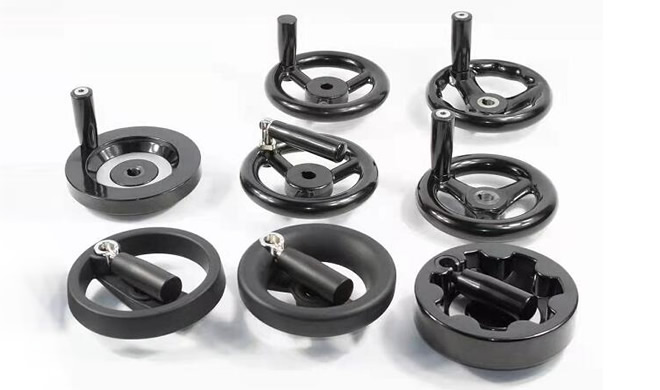
When configuring manual adjustment units for factory‑automation equipment, handwheel selection directly impacts operating comfort, positioning accuracy and overall machine layout. Multiple factors including diameter, material, structure and mounting form must be fully evaluated before finalizing a model.
How Handwheel Diameter Influences Operating Force
Handwheels generate torque by leveraging the radius of rotation to overcome mechanical resistance from the connected mechanism. With a larger‑diameter handwheel, the force application point sits further from the rotational center. Given equal human‑applied force, it delivers higher output torque and reduces the physical effort required to drive the same load.
Conversely, a smaller handwheel shortens the force arm. To achieve equivalent output torque, operators must exert greater hand force, which leads to obvious fatigue after repeated manipulation. For mechanisms requiring frequent adjustment or handling heavy loads, larger‑diameter handwheels are generally preferred to mitigate operating resistance.
Relationship Between Handwheel Diameter and Torque
The driving torque produced by a handwheel is determined by applied operating force and effective operating radius. When high adjustment torque is demanded, increasing handwheel diameter extends the force arm, allowing operators to complete tuning with minimal physical input. Typical applications include ball‑screw lifting assemblies, clamping units and large manual adjusting devices. These mechanisms suffer substantial internal friction and working loads, so insufficient handwheel size will result in noticeably stiff operation.
Nevertheless, handwheel diameter cannot be increased without bounds. Oversized handwheels consume valuable installation space on automation machinery and degrade operational agility. Engineers must strike a practical balance between available footprint and required torque output.
Selecting Handwheel Diameter for Different Application Scenarios
For fine‑tuning precision mechanisms, excessively large handwheels are not recommended. Precision‑oriented equipment prioritizes subtle incremental movement and tactile feedback. Though a big handwheel cuts down operating force, it amplifies linear displacement per unit rotation angle and impairs fine manual control.
Mechanisms for heavy‑duty adjustment such as clamping modules, lifting stations and manual positioning systems benefit from larger‑diameter handwheels to reduce operator burden. Where mounting space is constrained, compromise between acceptable operating force and spatial envelope becomes essential, preventing the handwheel from interfering with surrounding machine components.
Do Material and Construction Affect Operating Performance?
Beyond diameter, handwheel construction shapes real‑world handling experience. Handwheels fitted with revolving grip handles enable ergonomic force application, which is especially advantageous under high‑frequency rotation cycles. Surface texture, anti‑slip treatment and material hardness also govern force‑transfer efficiency. Over‑smooth surfaces tend to cause slippage and indirectly raise effective operating effort.
In addition, handwheel mass and moment of inertia influence manipulation feel. While heavy large‑size handwheels lower sustained‑turning effort, extra inertia must be overcome to initiate rotation. This effect deserves attention for frequently actuated manual stations.
Frequently Overlooked Points During Handwheel Sizing
A common misconception is that bigger handwheels always deliver better usability. If the downstream transmission suffers binding, poor lubrication or assembly defects, fitting a larger handwheel only masks symptoms instead of resolving root‑cause mechanical problems.
Moreover, larger handwheels are not inherently suitable for high‑precision positioning. Excessive available torque may blunt an operator’s ability to perceive tiny positional changes. Proper handwheel specification calls for comprehensive evaluation of actuation frequency, required adjustment torque, spatial constraints and accuracy targets.
Procurement Recommendations
Avoid selecting handwheels solely based on bore diameter. Validate working conditions to confirm suitable handwheel diameter, mounting style, rotation type and load capacity. For high‑frequency manual adjustment, prioritize ergonomics and anti‑slip surface properties. For heavy‑load tuning mechanisms, opt for larger‑diameter variants capable of supplying sufficient input torque.
Always verify mating compatibility with drive shafts, lead screws and adjustment assemblies. Excessive mounting clearances will degrade final positioning accuracy of the whole manual unit.
Risks and Common Misunderstandings
Larger handwheel diameter does not guarantee superior adjustment performance. Over‑dimensioned handwheels expand space requirements and slow down manual operation speed, making them unsuitable for many compact automation setups.
Difficult manual operation is not always caused by improper handwheel size. Abnormal internal resistance, degraded lubrication or worn transmission parts can produce stiff turning. Simply upgrading to a bigger handwheel will not fix underlying mechanical failures.
FAQ
Q: Does a larger handwheel always mean less operating force?
A: With identical mechanism resistance, a larger handwheel provides longer moment arm and generates higher torque, which normally reduces required manual force.
Q: What applications suit small‑diameter handwheels?
A: Small handwheels fit equipment with limited installation space, light adjustment loads or scenarios requiring quick manual manipulation.
Q: Should precision‑adjustment mechanisms adopt large‑size handwheels?
A: Not necessarily. Fine adjustment relies heavily on tactile control and subtle tuning capability. Handwheel dimensions shall be matched to practical accuracy objectives.
Q: Why does operation still feel heavy after switching to a larger handwheel?
A: Excessive internal mechanical resistance is the likely cause, such as worn lead screws, inadequate lubrication or mis‑aligned assembly, rather than handwheel specifications.
Q: Apart from diameter, what other parameters need review for handwheels?
A: Key specifications include mounting bore size, material grade, structural style, rotation configuration and service environmental conditions.
Copyright © 2016-2025 Forrun (Guangdong) Industrial Technology Co., Ltd All Rights Reserved.


