- Contact Us
- -
- Payment
- -
- 中文版
Knowledge Center · 2026-08-13 09:53:30 · 146 hits
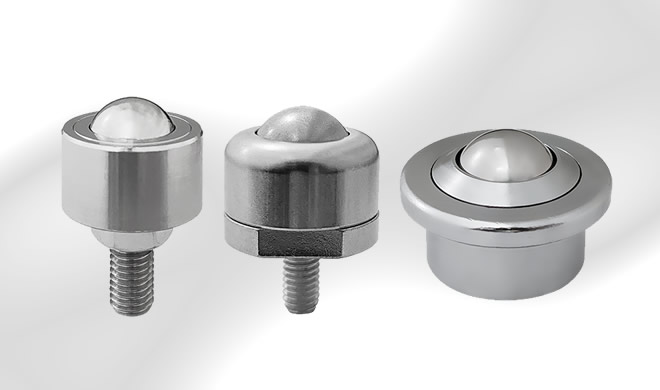
The ball diameter of ball transfer units shall be determined comprehensively based on workpiece weight, contact‑support area and conveying requirements. Larger ball diameter does not always equate to better performance.
Ball diameter defines the contact condition between ball transfer units and workpieces, and further determines load‑bearing capacity and rolling performance. An undersized ball increases the pressure acting on each individual unit, which accelerates component wear and raises rolling resistance. Conversely, excessively large balls limit the quantity of installable units per unit area, resulting in insufficient supporting stability for small‑size workpieces. It is critical to select proper ball specifications according to conveyed objects and field operating conditions.
Workpiece weight serves as the primary reference index.Heavier workpieces impose higher load demands on each ball transfer unit. Engineers may adopt larger‑diameter balls or increase the total quantity of units to reduce point‑load stress.
The bottom dimension of workpieces also requires careful evaluation.Oversized balls for workpieces with small base areas will reduce the number of effective contact points and weaken supporting stability. For large‑base workpieces, larger ball diameters are preferred to achieve higher load capacity.
Movement mode is another critical consideration.Worktables requiring frequent manual pushing, steering and positioning need balanced rolling flexibility and supporting rigidity. Continuous conveying equipment puts more emphasis on load capacity and wear resistance.
Besides, workpiece material, bottom‑surface flatness, travelling speed, mounting pitch and ambient conditions jointly govern final ball‑diameter specification. For scratch‑prone parts such as glass components and precision machined pieces, ball material and contact characteristics shall also be taken into full account.
Symptoms including stiff pushing action, jerky movement, local workpiece sinking or abnormally fast ball wear indicate improper ball‑diameter matching.First verify whether the workpiece bottom obtains uniform support from multiple ball transfer units, preventing full load carried merely by a small number of individual units. Next check rolling smoothness, identifying jamming, inflexible rotation or localized heavy wear. Observe obvious shaking, tilting or poor directional control during workpiece transportation. Persistent ball abrasion, housing deformation and rising rotational resistance imply mismatched ball diameter, load rating or mounting pitch against practical working conditions, which calls for comprehensive assessment and parameter adjustment.
Apart from ball diameter, users shall pay attention to rated dynamic load, installation height, mounting type, material grade and sealing structure. For heavy‑duty applications, confirm that units satisfy long‑term continuous dynamic load requirements rather than only short‑term static load capacity. Under dusty, humid or corrosive surroundings, select ball transfer units with reliable sealing and corrosion‑resistant materials to mitigate internal wear caused by foreign‑particle ingress. Reasonable mounting‑pitch design guarantees adequate supporting points for workpieces at all positions, improving conveying stability and avoiding concentrated local stress.
Ball diameter selection for ball transfer units depends on workpiece weight, base dimension, movement pattern and operating environment, instead of simply pursuing maximum ball size. Too small ball diameter leads to insufficient load capacity and accelerated wear; overly large ball diameter compromises supporting stability. Optimized matching among ball diameter, mounting pitch and rated load, together with application‑oriented system design, ensures smooth workpiece handling and extends service life of both ball transfer units and the whole conveying system.
Q: Does larger ball diameter mean higher load capacity for ball transfer units?
A: Generally, larger‑size balls deliver higher load‑bearing potential. Nevertheless, internal mechanical structure, raw material and official rated load shall be integrated for final confirmation.
Q: Are large‑diameter ball transfer units suitable for small‑sized workpieces?
A: Not necessarily. Excessively large balls may result in insufficient contact points on workpiece bottoms and poor supporting stability. Specifications shall match actual workpiece dimensions.
Q: What is the correlation between ball transfer unit quantity and ball diameter?
A: These two parameters need collaborative design. Increasing unit quantity helps distribute applied load, while mounting pitch and ball diameter must keep compatible with workpiece geometry.
Q: What causes inflexible rotation of ball transfer units?
A: Possible root causes include dust contamination, insufficient lubrication, sustained overloading, internal component degradation or improper selection of ball diameter and load rating.
Q: How to prolong the service life of ball transfer units?
A: Proper selection of ball diameter and rated load, uniform layout of mounting positions, avoidance of continuous overload operation, together with regular debris cleaning and rolling‑condition inspection, effectively extend the service life of ball transfer units.
Copyright © 2016-2025 Forrun (Guangdong) Industrial Technology Co., Ltd All Rights Reserved.


