- Contact Us
- -
- Payment
- -
- 中文版
Knowledge Center · 2026-09-01 09:41:11 · 186 hits
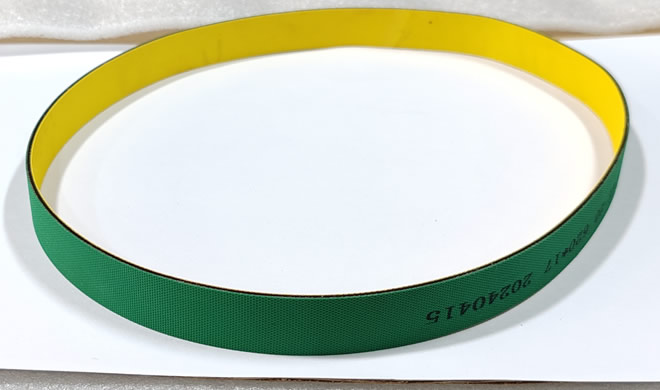
Stable operation of flat belts relies on balanced tension across both belt edges and uniform contact force from pulleys. When tension becomes higher on one side, or contact conditions between pulleys and the belt turn inconsistent, the belt will gradually drift toward the higher‑force side. Belt mis‑tracking is rarely triggered by a single defective component; it arises from combined interactions among the belt, pulleys, machine frame and applied load.
Non‑parallel alignment between drive pulley and idler pulley generates continuous lateral force during belt travel. Angular offset between pulley axes and machine reference surfaces will result in persistent one‑side drift right from equipment startup. This error is magnified notably in long‑distance conveying systems. When tracking deviation occurs, technicians shall first verify pulley parallelism and check for deformed mounting brackets, instead of adjusting belt tension blindly.
Asymmetric pulling force takes place when tension differs between left and right edges of the flat belt. This condition originates from improper initial tensioning during installation, or partial permanent elongation after long‑time service. Even with perfectly aligned pulleys, the belt will keep drifting toward the higher‑tension edge. If drift direction changes obviously while tuning the tension mechanism, focus inspection shall target tension uniformity and the tensioner assembly.
Long‑term cyclic operation may lead to edge abrasion, localized stretching, geometrical distortion or uneven belt splices. Once dimensional inconsistency emerges across the belt width, maintaining a stable travel path becomes challenging. Poor‑quality splices are especially problematic under high‑speed conditions, bringing about periodic tracking deviation and mechanical vibration. Where pulleys and tension settings are validated yet mis‑tracking persists, physical condition of the belt itself requires thorough examination.
For conveying applications, material accumulating persistently on one side creates unbalanced loading across the belt width. Such offset load not only triggers belt drift, but also introduces excessive localized stress on pulleys, bearings and structural frames. If pulley misalignment already exists within the system, negative impacts caused by eccentric load will be further amplified.
A frequent field practice is adjusting tension devices immediately upon observing belt drift. Nevertheless, if the root cause lies in non‑parallel pulleys, simply raising tension cannot eliminate tracking issues, and will accelerate wear of both belt and bearing assemblies. Another misunderstanding attributes all tracking problems purely to poor belt quality. In reality, installation accuracy, pulley condition and load distribution can equally contribute to severe flat‑belt mis‑tracking.
What are the most frequent causes for flat‑belt tracking deviation?
Pulley non‑parallelism, shaft misalignment, uneven tension and belt deformation represent typical root causes.
Why does the flat belt always drift toward the identical side?
This phenomenon is generally associated with pulley installation offset, unbalanced edge tension or directional deformation of the belt body.
Will higher belt tension prevent tracking deviation?
No. Excessive tension increases system stress. Reasonable and evenly distributed tension is the key factor instead.
Can belt splices lead to mis‑tracking?
Yes. Crooked, uneven or thickness‑varied splices produce periodic tracking deviation during running cycles.
Which items shall be inspected first for flat‑belt drift troubleshooting?
Prioritize pulley parallelism and shaft alignment checks, then proceed to evaluate tension status, belt wear condition and load distribution.
Copyright © 2016-2025 Forrun (Guangdong) Industrial Technology Co., Ltd All Rights Reserved.


