- Contact Us
- -
- Payment
- -
- 中文版
Knowledge Center · 2026-10-14 09:15:00 · 16 hits
1. Overview
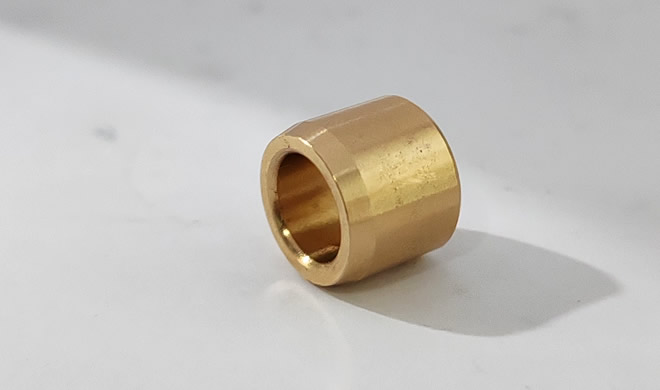
Copper alloy bushings (also referred to as bronze bushings or sleeve bearings) are wear-resistant components manufactured from a copper base alloyed with elements such as tin, aluminum, zinc, and nickel. They are widely used at sliding interfaces in machinery, automotive systems, construction equipment, and pump-and-valve assemblies. By combining good thermal conductivity, inherent self-lubricating behavior, and corrosion resistance, copper alloy bushings solve bearing problems in applications involving high loads, low speeds, intermittent motion, or difficult lubrication access.
2. Temperature Range by Alloy Type
The service temperature of a copper alloy bushing is primarily governed by its alloy composition and the operating conditions. The representative grades below follow GB/T 1176 (cast copper alloys); international buyers should map them to the equivalent local standard.
| Alloy type | Representative grade (GB/T 1176) | Service temperature range | Notes |
|---|---|---|---|
| Tin bronze bushing | ZCuSn10Pb1 | −40 °C to 250 °C | With intermittent duty or good oil lubrication, can briefly tolerate higher peaks |
| Aluminum bronze bushing | ZCuAl10Fe3 | −40 °C to 300 °C | More stable than tin bronze under heavy load and high speed |
| High-strength lead bronze bushing | Lead-bronze grade (ZCuPb-type) | −30 °C to 220 °C | Suited to poor-lubrication conditions; not recommended for sustained high temperature |
| Graphite-embedded copper bushing | Solid-lubricant type | up to ~350 °C | Runs oil-free; ideal for high-temperature intermittent motion |
Note: ZCuSn10Pb1 and ZCuAl10Fe3 are Chinese GB/T designations. Functionally similar alloys exist under DIN/EN and UNS systems; confirm the nearest equivalent with your supplier before specifying.
3. Factors Affecting Temperature Performance
Lubrication condition: Adequate lubrication markedly raises the practical upper temperature limit of the bushing.
Load magnitude: Higher loads demand greater material thermal stability, since heat generated at the contact surface scales with load.
Motion profile: High speed or frequent start-stop cycles generate substantial frictional heat; in such cases the bushing's ability to dissipate heat becomes the limiting factor.
Fit clearance and thermal expansion: Heating expands both the bushing and the shaft; the design must reserve a thermal-expansion allowance so the running clearance stays within tolerance.
4. Selection & Usage Recommendations
For equipment running continuously at high temperature, choose graphite-embedded copper bushings or a specially formulated high-temperature alloy.
For general industrial machinery with sufficient oil lubrication, standard copper alloy bushings usually provide adequate temperature performance.
Avoid prolonged operation at the extreme ends of the temperature range to maximize bushing service life.
Quick-selection tip: Match the alloy to the dominant duty — tin bronze for general oily service, aluminum bronze for heavy/high-speed load, lead bronze for marginal lubrication, and graphite-embedded for oil-free high-temperature operation.
5. Selection by Lubrication Medium
Beyond alloy family, the surrounding medium dictates the most suitable bushing. The matrix below maps common operating media to a recommended type and its temperature caveat.
| Operating medium | Recommended bushing | Temperature note |
|---|---|---|
| Oil-lubricated | Tin / aluminum bronze | Full rated range; oil extends the practical upper limit |
| Dry / oilless | Graphite-embedded copper | Up to ~350 °C; no external lubricant required |
| Water / aqueous | Aluminum bronze (corrosion-resistant) | Watch for cavitation/erosion; ≤ ~200 °C typical |
| Food-grade / hygienic | Lead-free bronze or compliant coating | Verify FDA / EC 1935 compliance; temperature per base alloy |
6. Temperature-Related Failure Modes
Understanding how failure develops as temperature moves out of range helps in setting safe operating limits.
| Condition | Failure mode | Root cause |
|---|---|---|
| Near upper limit, oil-lubricated | Oil-film breakdown → scoring | Lubricant loses viscosity / oxidizes |
| Sustained > ~300 °C | Oxidation / surface scaling | Copper alloy surface oxidizes under heat |
| Graphite bushing > ~350 °C | Solid-lubricant degradation | Embedded graphite loses effectiveness |
| Rapid thermal cycling | Dimensional change → seizure | Insufficient thermal-expansion allowance |
| Below ~−40 °C | Embrittlement risk | Material ductility drops at low temperature |
7. Thermal Expansion Allowance — Quick Calculation
Heating changes the bushing bore (and the shaft) diameter. Reserve clearance using linear expansion:
ΔD ≈ α · D · ΔT
Where α ≈ 18 × 10⁻⁶ /°C for copper alloys, D is the bore diameter, and ΔT is the temperature rise above assembly condition.
Example: A bushing bore D = 20 mm operates at ΔT = 150 °C above assembly.
ΔD ≈ 18 × 10⁻⁶ × 20 × 150 ≈ 0.054 mm bore expansion. The shaft expands similarly, so the running clearance shrinks by roughly this amount on the diameter — design the initial fit clearance to absorb it, or the bushing may bind at temperature.
Copyright © 2016-2025 Forrun (Guangdong) Industrial Technology Co., Ltd All Rights Reserved.


