- Contact Us
- -
- Payment
- -
- 中文版
Knowledge Center · 2026-10-19 09:42:19 · 21 hits
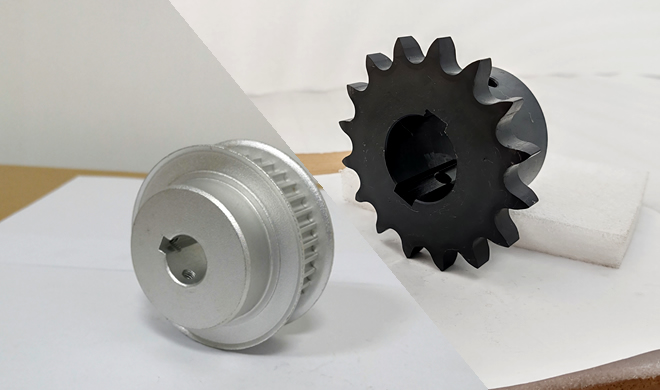
1. Chain vs. Synchronous Belt — What's the Difference
The main distinction lies in how power is transmitted. A chain drive delivers power through the meshing of a chain with sprocket teeth; it offers strong load-carrying capacity and shock resistance, suiting heavy, long-distance, and environmentally harsh transmission duty. A synchronous belt (timing belt) transmits power via the meshing of belt teeth with pulley grooves; it generates no lubrication contamination, runs smoothly with low noise, and fits precision drives in automation equipment. Neither is absolutely superior — the right choice matches the equipment's load, speed, accuracy, and operating environment.
| Aspect | Chain drive | Synchronous belt |
|---|---|---|
| Transmission method | Chain–sprocket tooth meshing | Belt–pulley toothed meshing |
| Load capacity | High, shock-resistant | Moderate |
| Lubrication | Required | None needed |
| Noise / vibration | Higher | Lower |
| Precision & stability | Lower (pitch change, stretch) | Higher (stable ratio) |
| Environment tolerance | Dirty / oily / high-temp tolerant | Best in clean environments |
| Maintenance | Regular lube & tension check | Tension & wear check |
| Typical best fit | Heavy, long-distance, impact | Precision automation, high speed |
2. Load Capacity — How to Choose
If the equipment must transmit large torque or absorb impact loads, chain drive usually wins. The chain's high mechanical strength makes it common in heavy conveyors, mining, and construction machinery; with proper lubrication and maintenance it delivers long service life. A synchronous belt also carries load, but belt material and tooth strength limit it — under extreme load or strong impact, tooth damage, elongation, or tooth skipping (belt jump) can occur. Rule of thumb: heavy, low-speed, high-torque equipment → chain; small-to-medium load automation → belt.
3. Precision and Running Stability
Where positioning accuracy and smooth motion matter, synchronous belt usually has the edge. Its toothed meshing keeps a stable transmission ratio with low vibration and noise — ideal for automation equipment, handling/transfer modules, and inspection mechanisms. A chain drive, affected by pitch variation, wear elongation, and its multi-link structure, tends to develop changing transmission backlash/play over time, making it less suitable for high-precision positioning. Robots, production lines, and precision stages therefore commonly use belts.
4. High-Speed Operation
At high speed, watch vibration, noise, and dynamic stability. Chain drives can induce chain vibration, impact, and noise at speed, and need good lubrication — otherwise wear accelerates sharply. Synchronous belts run more smoothly, need no lubrication, and suit high-speed reciprocating equipment, though tension state and pulley accuracy must be controlled to avoid skipping. High-speed automation generally favors belts; low-speed continuous duty can use chain based on load.
5. How the Environment Influences the Choice
The operating environment is decisive. In dust, oil, high temperature, or impact conditions, chain drive adapts better but needs periodic lubrication and maintenance. In clean environments such as electronics assembly and inspection, synchronous belt is advantageous — no oil contamination and lower upkeep. For cleanliness-critical industries like food and pharmaceutical, belt drives are typically preferred.
6. Commonly Overlooked Issues
Many users assume "chain carries more, so always choose chain" — but in precision automation, chain stretch and running play can hurt positioning accuracy.
Others assume belts "need no maintenance" — in reality belts still require periodic checks of tension, tooth-face wear, and pulley meshing.
Drive selection should never rest on a single parameter; weigh load, speed, accuracy, environment, and maintenance together.
Selection decision matrix:
| If your priority is… | Choose |
|---|---|
| Heavy load / shock resistance | Chain drive |
| Positioning precision / stability | Synchronous belt |
| High speed / low noise | Synchronous belt |
| Harsh / dirty / oily / high-temp | Chain drive |
| Clean / food / pharmaceutical | Synchronous belt |
| Long-distance transmission | Chain drive |
7. FAQ
Q: Which lasts longer, chain or synchronous belt?
It depends on conditions. Chain leads in heavy/impact duty; belts hold stable performance better in precision automation.
Q: Can a synchronous belt replace a chain drive?
In some applications, yes — but confirm that load, speed, and installation constraints meet belt requirements.
Q: Why do high-speed machines favor belts?
Belts run smoothly, quietly, and without lubrication, suiting high-speed motion.
Q: Does chain drive need frequent maintenance?
Yes. Chains need regular lubrication and tension checks, or wear and noise increase.
Q: Which should automation equipment prioritize?
If precision, speed, and cleanliness matter, favor the synchronous belt; if large load and shock resistance matter, the chain is better.
8. Quick-Selection by Load × Speed × Precision
A faster way to decide is to read the three axes together. Precision need is the tie-breaker: whenever high positioning accuracy is required, the synchronous belt is usually preferred regardless of the other two.
| Load level | Speed | Precision need | Recommended drive |
|---|---|---|---|
| Light – medium | Low or high | Standard | Synchronous belt (chain if environment is harsh) |
| Light – medium | Low or high | High | Synchronous belt |
| Medium – heavy | Low | Standard | Chain drive |
| Medium – heavy | High | Any | Belt if load permits; otherwise chain |
| Heavy | Any | Any | Chain drive |
When in doubt, start from precision: high accuracy → belt; otherwise let load and environment decide.
9. Synchronous Belt Tensioning and Center-Distance Calculation
Setting tension (deflection method). Apply a perpendicular force F at the midpoint of a straight belt span of length L_s and measure the resulting deflection δ. Belt tension is approximated by:
T ≈ F · L_s / (4 · δ)
Example: Span L_s = 300 mm, applied force F = 10 N, measured deflection δ = 5 mm.
T ≈ 10 × 300 / (4 × 5) = 3000 / 20 = 75 N. Set the belt to roughly this tension, then verify against the catalog's specified static tension.
Center-distance relation. For a synchronous belt the pitch length L_p relates to the center distance C and pulley pitch diameters D₁, D₂ by:
L_p = 2C + (π/2)(D₁ + D₂) + (D₂ − D₁)² / (4C)
Example (equal pulleys): L_p = 1000 mm, D₁ = D₂ = 80 mm.
L_p = 2C + (π/2)(160) + 0 = 2C + 251.3 = 1000 → 2C = 748.7 → C ≈ 374 mm.
For unequal pulleys, solve by iteration (or use the manufacturer's belt-length calculator); always leave an adjustment margin for tensioning.
Copyright © 2016-2025 Forrun (Guangdong) Industrial Technology Co., Ltd All Rights Reserved.


