- Contact Us
- -
- Payment
- -
- 中文版
Knowledge Center · 2026-10-20 09:43:30 · 19 hits
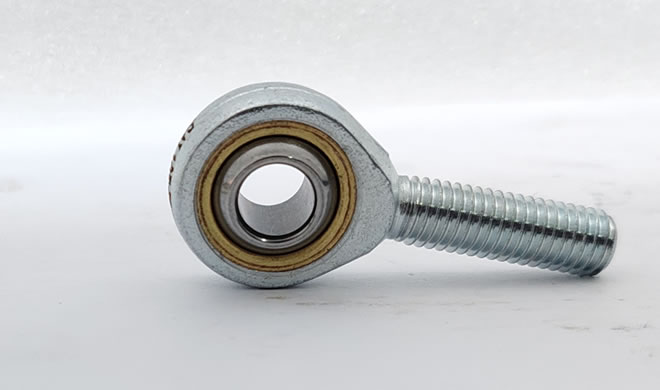
1. Definition and Function
① Definition. A spherical plain bearing is a bearing built to accommodate combined loads — both radial and axial — with high impact resistance and wear resistance. Compared with conventional sliding (plain) bearings, it offers longer service life and better self-lubricating behavior.
② Function. It is used in mechanical parts that must rotate or oscillate within a certain angular range — for example, construction and agricultural machinery. By reducing friction and wear, it raises mechanical efficiency and extends equipment life.
Editor's note: In standard bearing terminology, a spherical plain bearing is a sliding (plain) bearing with spherical contact surfaces — not a rolling-element bearing. The "spherical / needle-like" form mentioned in the source material refers to the geometry of the spherical sliding contact surface, not to separate rolling elements. We keep the functional description but clarify the classification for technical accuracy.
2. Classification, Names, and Principle
① By material
| ype | Property | Typical use |
|---|---|---|
| Steel spherical plain bearing | High strength, corrosion-resistant; tolerates high temperature / pressure | Harsh operating environments |
| Plastic spherical plain bearing | Light weight, low cost | Light-load, high-speed applications |
| Stainless steel spherical plain bearing | Excellent corrosion resistance, biocompatible | Food processing, medical equipment |
② By structure
| Type | Property | Typical use |
|---|---|---|
| Open type | Simple; easy to install and maintain | General industrial environments |
| Sealed (closed) type | Sealed ends block dust and debris | High-cleanliness environments |
| Self-lubricating type | Built-in lubricant; no added lube needed | Low-maintenance duty |
③ Working principle. Load is transferred through the spherical sliding contact between the inner and outer rings, permitting the shaft or housing to move relative to each other in one or more directions (angular misalignment, oscillation). Special surface treatments and material choices further raise load capacity and service life.
3. Installation and Maintenance
① Preparation. Clean the bearing housing and journal, ensuring no oil, swarf, or other contaminants. Verify fit dimensions to avoid problems caused by an over-tight or over-loose fit.
② Correct installation. Use dedicated mounting tools; never strike the bearing directly, as this causes damage. For self-lubricating types, check that the lubricant is sufficient during installation.
③ Maintenance. Periodically inspect the bearing's running condition for abnormal noise or vibration. Depending on the environment, replenish or replace lubricant on schedule to keep lubrication healthy.
Installation checklist:
Housing and journal cleaned of contaminants
Fit dimensions verified (not too tight / too loose)
Dedicated tools used — no direct impact on bearing
Self-lube lubricant level confirmed
Scheduled noise / vibration inspection in place
4. Application Cases
| Sector | Example equipment | Benefit of spherical plain bearing |
|---|---|---|
| Construction machinery | Excavators, loaders | High load and impact resistance → stability and work efficiency |
| Agricultural machinery | Combine harvesters, tractors | Withstands field conditions; reliable continuous duty; lower repair cost |
| Medical equipment | Operating tables, X-ray machines | Stainless, biocompatible, corrosion-resistant; precise motion control for safety and accuracy |
5. Type Designation (Model Codes)
To address the "model" part of the topic: spherical plain bearings follow standard series codes such as the GE series under ISO 12240 / DIN 648, typically written as GE + bore-diameter code + suffix (e.g., GE 20 ES). Rod-end (spherical) bearings use separate prefixes (e.g., SI / SIL). Suffixes denote features such as maintenance-free liners, sealing, or width series. Always confirm the exact meaning against the specific manufacturer's catalog, since codes vary by standard and supplier.
6. Load Rating and Selection
Because a spherical plain bearing is a sliding bearing, it is selected differently from a rolling bearing — primarily on static load capacity and contact stress (specific pressure), not on a rolling-element dynamic-life formula.
Static load rating C₀: the catalog maximum static load (radial or axial) the bearing can carry without permanent deformation. Applied load must stay within C₀ (with a safety factor for shock).
Specific contact pressure the average surface pressure on the spherical contact:
p = F / (dₘ · B) [MPa, with F in N, dₘ and B in mm]
where dₘ is the mean contact diameter and B the bearing width. Keep p below the allowable limit given in the catalog (steel-on-steel is typically higher than a PTFE-lined pair).
pv value: the product of contact pressure (p) and sliding velocity (v = π·dₘ·n/60 000, m/s). Staying under the rated pv limit is the key to wear life for the sliding pair.
Worked example (GE 20): mean diameter dₘ ≈ 29 mm, width B = 14 mm, radial load F = 20 kN.
p = 20 000 / (29 × 14) = 20 000 / 406 ≈ 49 MPa — within typical steel-on-steel allowances.
Rod-end (spherical) bearings are selected the same way — by static load rating and allowable misalignment — and are rated for oscillating, not continuous high-speed rotation.
7. Maintenance-Free PTFE-Liner Selection
Maintenance-free (self-lubricating) spherical plain bearings use a PTFE (teflon) composite liner on the sliding surface instead of a greased steel-on-steel pair. The trade-offs:
#
Selection rule: choose PTFE-lined for low-maintenance and clean environments at light-to-medium load; choose steel-on-steel (with relubrication) when load, pv, or temperature exceeds the liner's limits. Always confirm allowable p and pv against the manufacturer's catalog.
Copyright © 2016-2025 Forrun (Guangdong) Industrial Technology Co., Ltd All Rights Reserved.


