- Contact Us
- -
- Payment
- -
- 中文版
Knowledge Center · 2026-11-13 09:39:58 · 23 hits
1. Why Chain Designations Matter
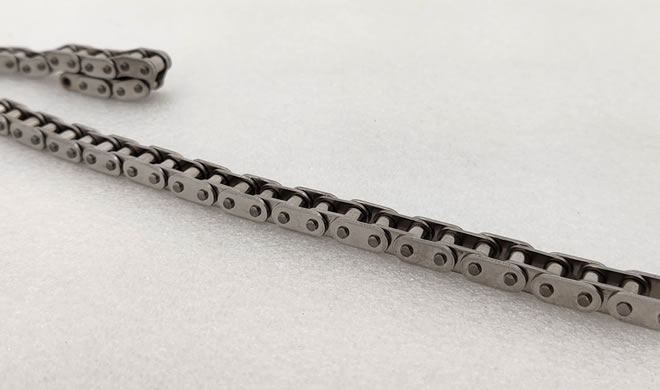
Chains are used across transmission, conveying, and lifting duties. A model code is more than a part number — it encodes the chain's size, geometry, and intended use. Reading it correctly keeps selection, replacement, and maintenance disciplined and avoids mismatched fitment.
A designation typically carries these pieces of information:
Pitch (P): the distance between the centers of two adjacent rollers — the single most important parameter.
Roller diameter (d).
Inner width (b1).
Configuration code: single/double strand, with guide, with attachments, etc.
Standard family: ISO, ANSI, DIN, JIS, and so on.
Key designation parameters:
| Parameter | Symbol | Meaning |
|---|---|---|
| Pitch | P | Center distance between adjacent rollers; sets sprocket tooth size |
| Roller diameter | d | Diameter of the roller that engages the sprocket |
| Inner width | b1 | Clear width between inner plates; sets roller seating |
| Configuration | — | Strand count, guide, attachments |
2. Common Chain Types
2.1 By international standard
ISO chains — e.g., 08B, 10B, 16B. Metric, used in European-standard systems and common in machinery and light industry.
ANSI chains — e.g., #40, #50, #80. Inch-based, widespread in North America and parts of Asia.
JIS chains — Japanese standard, e.g., RF2040, RF2050. Compact, suited to precision equipment.
Standard families at a glance (pitch reference — approximate):
| Standard | Example | Pitch (approx.) | Typical use |
|---|---|---|---|
| ISO | 08B / 10B / 16B | 12.7 / 15.875 / 25.4 mm | General machinery, light industry |
| ANSI | #40 / #50 / #80 | 0.5 / 0.625 / 1.0 in | North America, broad industry |
| JIS | RF2040 / RF2050 | ~12.7 / ~15.875 mm | Precision, compact equipment |
2.2 By strand count
Single strand: one row of links and rollers; simple, for medium-to-light duty.
Double strand: two parallel rows, higher load capacity, for medium-to-heavy duty.
Triple strand: three rows, for heavy, high-speed drives such as mining and metallurgy.
2.3 By special purpose
| Type | Code example | Feature / use |
|---|---|---|
| Conveyor chain | P-type, C-type | With plastic slats or attachments for material handling |
| Guided chain | 10A-G ("G") | Side guide prevents lateral sway |
| Agricultural chain | CA550, CA620 | For combines and farm machinery |
| Stainless steel chain | SS40 ("SS") | Food, pharma, and clean environments |
| Heavy series | H80 ("H") | Thicker plates and larger rollers for impact loads |
3. Selection Advice
Define the environment: temperature, corrosion, dust, or heat decides the material.
Verify the dimensions: pitch, inner width, and roller diameter must match the sprocket exactly.
Consider strength and speed: choose strand count, structure, and attachments to meet performance.
Match the standard system: the sprocket and chain must belong to the same national-standard family.
4. Interchangeability Note
A matching pitch does not guarantee interchangeability. ISO 08B, ANSI #40, and JIS RF2040 share a 12.7 mm pitch, but their roller diameter, inner width, and plate dimensions differ — so a chain and sprocket from different families will not mesh correctly even at the same pitch. Always keep the chain and sprocket within one standard system, and confirm roller diameter and inner width, not pitch alone.
5. FAQ
Q: Is 08B the same as #40?
Same 12.7 mm pitch, but different roller and inner-width dimensions — not directly interchangeable. Keep to one standard system.
Q: What does the "G" mean?
A guage/guided chain with a side guide to stop lateral sway in conveying.
Q: Which chain for a food line?
A stainless steel chain (SS series) for corrosion resistance and cleanability.
Q: How do I choose single vs. double strand?
Base it on load and speed; double strand roughly doubles the load capacity but check sprocket width too.
Q: Why won't my chain fit the sprocket despite matching pitch?
Pitch alone is insufficient — roller diameter and inner width also decide engagement.
Copyright © 2016-2025 Forrun (Guangdong) Industrial Technology Co., Ltd All Rights Reserved.


