- Contact Us
- -
- Payment
- -
- 中文版
Knowledge Center · 2026-08-26 10:05:50 · 295 hits
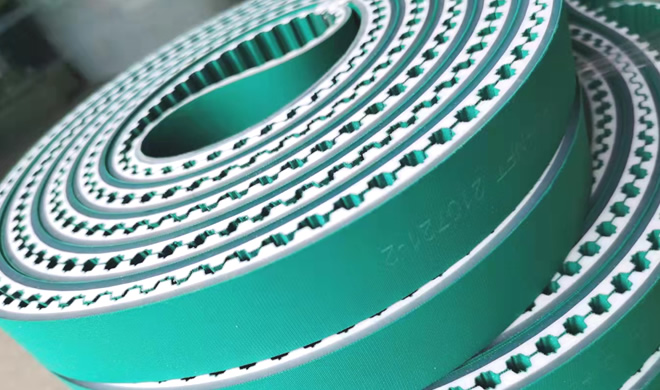
Timing belts are subject to a certain degree of elongation after prolonged operation. This physical phenomenon arises from material creep, internal structural fatigue, tension fluctuation and real‑world operating loads. Initial elongation mostly manifests as elastic stretch during the run‑in period, which is reversible to some extent. Nevertheless, as service hours accumulate, partial deformation will turn into irreversible permanent elongation. Without timely tension readjustment or component replacement, symptoms such as tooth jumping, positioning deviation and reduced transmission efficiency may occur. Continuous monitoring and standardized maintenance are therefore essential to mitigate risks brought by belt elongation.
Conveyor‑type timing belts are generally constructed with rubber base material and high‑strength tensile fiber cords. Under sustained tensile force, the composite material produces slow creep deformation.
At the early running stage, timing belts go through natural tension settlement. This phase corresponds to internal molecular and structural rearrangement, representing minor elastic elongation. Normal transmission performance can usually be restored by retightening the belt.
With extended operation, the inner fiber cords endure persistent tensile stress. Heavy payload or long continuous running hours trigger micro‑level fatigue inside fiber layers, giving rise to permanent non‑recoverable elongation.
Within roller‑driven systems, timing belts undergo repeated tension‑and‑release cycles from continuous bending and tooth meshing. Cyclic alternating stress accelerates fatigue accumulation of belt materials.
Ambient temperature is another critical influencing factor. High‑temperature surroundings soften rubber compounds, weaken tensile resistance and exacerbate stretching deformation.
Worn timing pulleys or installation eccentricity create uneven local stress distribution. Certain sections of the belt bear extra tensile load, speeding up overall length variation.
In essence, timing‑belt elongation is a combined effect of material creep and cyclic fatigue aggravated by operating conditions.
The most immediate consequence of belt elongation is tension loss. Insufficient tension destabilizes meshing between belt teeth and pulley grooves, greatly increasing the probability of tooth jumping.
For automated conveying systems, elongated timing belts degrade positioning accuracy. Varied belt length causes inconsistent motion cycles and disrupts equipment rhythm control.
Elongation also disturbs pitch matching and creates loose meshing conditions. Under high‑speed operation, poor meshing generates noticeable vibration and abnormal noise.
If the elongated belt remains in service without adjustment, local teeth will suffer accelerated abrasive wear, shortening the overall service life of the timing belt assembly.
In severe cases, excessive elongation may lead to tooth stripping or jamming, triggering equipment malfunction or unplanned downtime. Accordingly, belt elongation is far more than a dimensional change; it serves as an early warning signal jeopardizing system stability.
Re‑inspect and adjust belt tension promptly after initial commissioning and run‑in cycles
Keep operating load within rated range and avoid persistent over‑load conditions
Periodically inspect pulley tooth wear to guarantee meshing profile integrity
Prevent long‑term exposure to high‑temperature environments to slow down material creep
Select timing belts reinforced with high‑tensile‑strength fiber cords for demanding applications
Minimize frequent emergency start‑stop cycles to reduce impact tensile loads
Implement regular belt‑length inspection and establish standardized replacement intervals
Ensure precise coaxial alignment during installation to eliminate localized stress concentration
A certain level of elongation is inevitable for roller‑driven timing belts after long‑term service, resulting from the combined impact of material creep, fatigue accumulation and applied loads. Mild initial elongation falls within normal operating characteristics. However, uncontrolled progressive elongation will induce tooth jumping, vibration and accuracy deterioration. Proper tension management, load optimization and routine maintenance can effectively restrain excessive elongation and sustain reliable long‑run performance of automated conveying systems.
Copyright © 2016-2025 Forrun (Guangdong) Industrial Technology Co., Ltd All Rights Reserved.


