- Contact Us
- -
- Payment
- -
- 中文版
Knowledge Center · 2026-08-28 09:47:22 · 149 hits
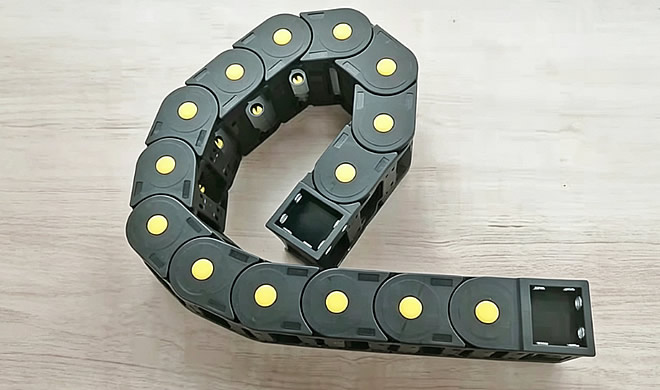
Although cable carriers offer defined bending clearance, the maximum permissible bend is practically constrained by the cables routed inside. During reciprocating motion, cables are continuously subjected to cyclic bending stress. If the cable‑carrier bending radius falls below the cable‑specified minimum dynamic bending radius, internal conductors, insulation layers and shielding structures endure excessive cyclic flexing. This eventually leads to conductor breakage, cracked insulation and unstable signal transmission. Accordingly, the minimum dynamic bending radius of cables shall be confirmed first, and the cable carrier bending radius shall be selected to satisfy this critical parameter.
General power cables, control cables, carrier‑grade cables and robot cables feature distinct internal constructions, resulting in different allowable dynamic bending performance. Standard stationary‑installation cables are designed for limited flexing cycles, whereas special carrier‑rated cables adopt optimized structures to withstand high‑frequency cyclic bending.
For signal‑related cables such as encoder cables, servo cables and Ethernet cables, extra attention shall be paid to shielding integrity and twisted‑pair characteristics. Even without visible physical fracture, long‑term over‑bending may degrade shielding performance and impair signal quality.
Cable outer diameter alone is insufficient for proper sizing. Always refer to the minimum dynamic bending radius published by the cable manufacturer as the primary design reference. When multiple cables are laid inside one carrier, the bending radius must comply with the cable with the largest required dynamic bending radius among the whole cable bundle.
Sufficient internal free movement space for cables must also be considered. Larger cable diameters, large cable quantities or integrated connectors will demand extra internal clearance, which indirectly influences the practical bending performance of the complete cable‑carrier assembly.
While meeting the minimum dynamic bending radius satisfies theoretical conditions, engineering practice requires reasonable safety margins. Under long‑term high‑speed reciprocating operation, cables endure combined loads including bending friction and inertial force. Operating persistently at the absolute limit will significantly shorten cable fatigue life. For equipment with high cycle frequency, high acceleration or non‑stop continuous operation, select an increased bending radius following cable vendor specifications instead of applying the bare‑minimum limit.
One typical misunderstanding assumes smaller bending radius equals better space‑saving performance, hence specifying the smallest available carrier size. Undersized bending radius subjects internal cables to persistent excessive bending stress and accelerates premature failure.
Another frequent error is selecting cable carriers purely based on cable outer diameter while ignoring dynamic bending specifications. Cables with identical outer dimensions can have substantially different allowable bending radii depending on their internal construction.
What key parameter determines cable carrier bending radius?
The primary reference is the minimum dynamic bending radius of internal cables. Cable outer diameter, cable quantity and actual operating conditions shall also be comprehensively evaluated.
Which cable governs bending‑radius selection for multi‑cable bundles?
Follow the cable with the strictest requirement, i.e. the one with the largest minimum dynamic bending radius.
Is a larger bending radius always better?
A larger radius is beneficial for cable service life, yet it occupies more installation space. A trade‑off between cable durability and mechanical layout space is required.
Do servo cables require special bending‑radius consideration?
Yes. Servo cables undergo continuous high‑speed cyclic motion and impose stringent requirements on dynamic bending resistance.
What failures will be triggered by insufficient bending radius?
Potential risks include conductor fatigue fracture, insulation damage, shielding deterioration and complete core wire breakage.
Copyright © 2016-2025 Forrun (Guangdong) Industrial Technology Co., Ltd All Rights Reserved.


